

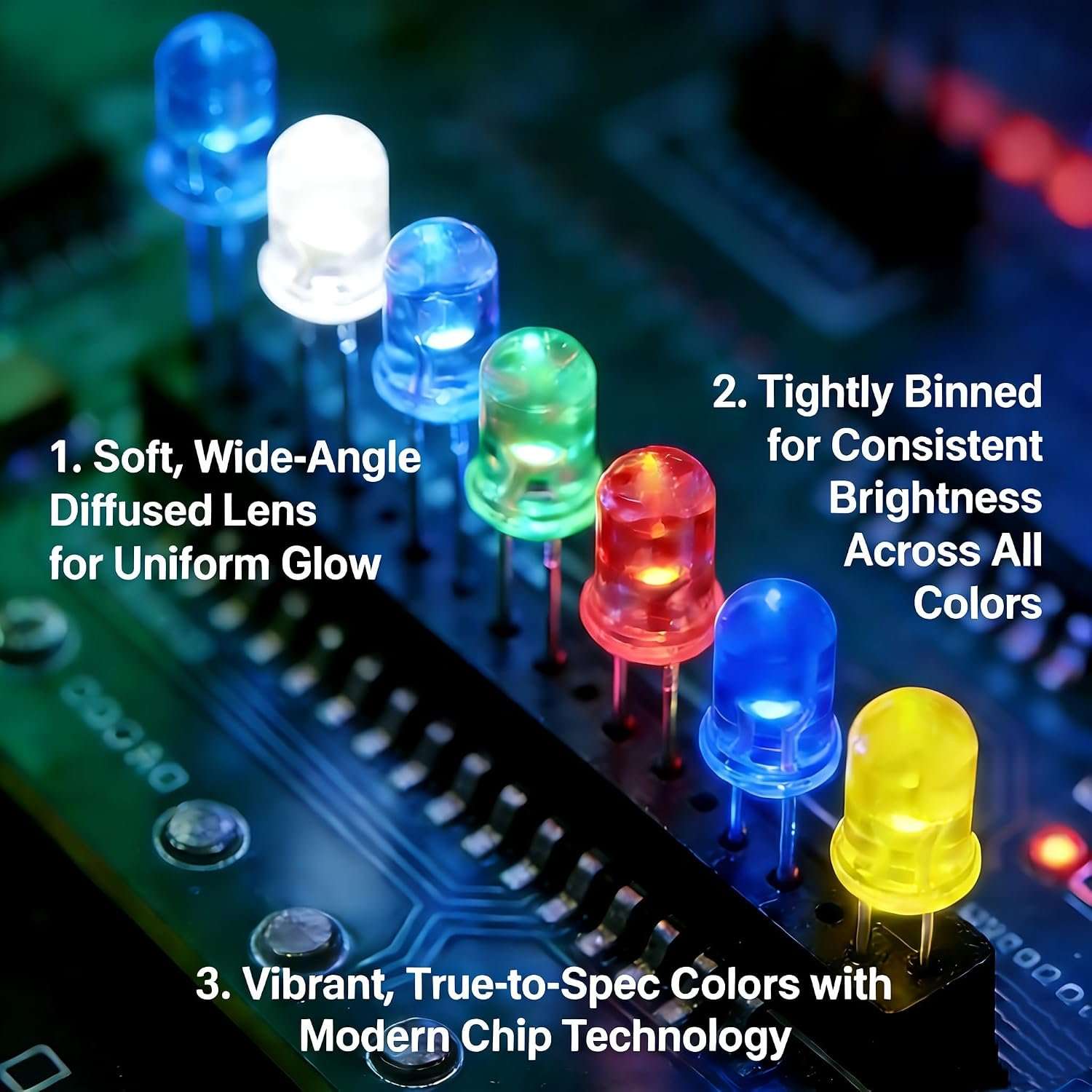

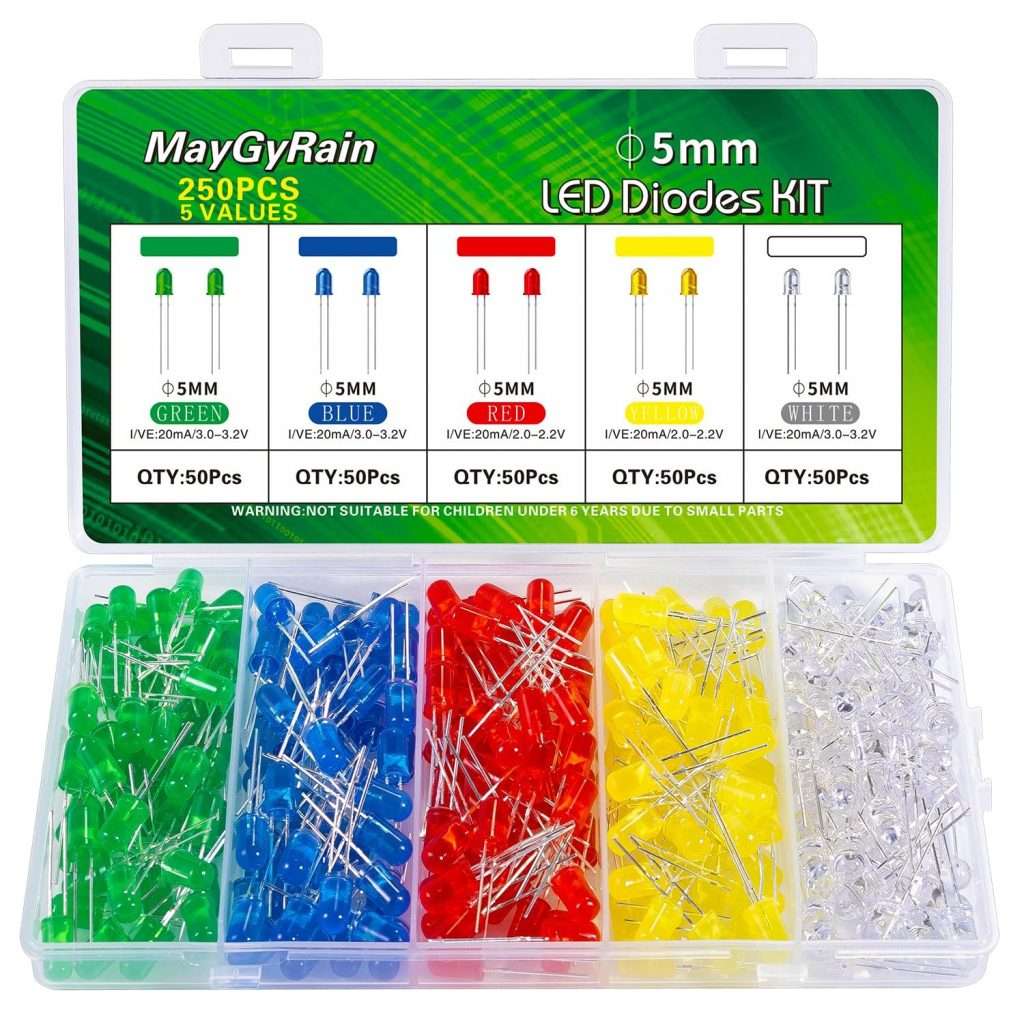
The 250 Pcs 5mm LED Diodes Kit 5 Values 5 Color Light Assortment Kit is a general-purpose assortment of through-hole light-emitting diodes designed for electronics prototyping, educational experiments, DIY projects, model building, robotics, indicator circuits, and decorative lighting. The kit contains 250 individual 5mm LEDs, divided evenly among five colors: red, yellow, green, blue, and white, with 50 pieces of each color.
The 5mm through-hole format is one of the most widely used LED packages for breadboards and conventional PCBs. Its two radial leads make polarity identification and hand assembly straightforward, while the approximately 5mm body provides a useful balance between visibility and compactness.
According to the available product specifications, the red and yellow LEDs have a typical listed forward-voltage range of approximately 2.0–2.2 V at 20 mA, while the green, blue, and white LEDs are listed at approximately 3.0–3.2 V at 20 mA. These values are particularly useful when selecting current-limiting resistors for individual LED circuits.
For example, when an LED is driven from a 5 V supply, a resistor is required to limit current. Using the nominal 20 mA figure, the approximate resistor calculation is:
R = (VCC − VF) / I
For a red LED with a 2.0 V forward voltage:
R ≈ (5 − 2.0) / 0.020 = 150 Ω
For a blue or white LED with a 3.2 V forward voltage:
R ≈ (5 − 3.2) / 0.020 = 90 Ω
In practical circuits, designers commonly select the next suitable standard resistor value and may intentionally operate the LED below its maximum/current reference for lower power consumption and longer service life. The exact forward voltage and luminous characteristics can vary between individual LEDs, so these calculations should be treated as design references rather than guaranteed values for every piece.
The kit is therefore particularly convenient when a project requires multiple LED colors without purchasing individual component reels or bags.
Technical Specifications
| Parameter | Specification |
|---|---|
| Product Type | 5mm Through-Hole LED Diode Assortment |
| Total Quantity | 250 pieces |
| LED Diameter | 5mm / approximately 0.2 inch |
| Number of Colors | 5 |
| LED Colors | Red, Yellow, Green, Blue, White |
| Quantity per Color | 50 pieces |
| Red Forward Voltage | Approximately 2.0–2.2 V |
| Yellow Forward Voltage | Approximately 2.0–2.2 V |
| Green Forward Voltage | Approximately 3.0–3.2 V |
| Blue Forward Voltage | Approximately 3.0–3.2 V |
| White Forward Voltage | Approximately 3.0–3.2 V |
| Listed Operating/Test Current | 20 mA |
| Mounting Type | Through-Hole |
| Package Style | 5mm radial LED |
| Storage | Clear organized plastic case |
| Primary Applications | DIY electronics, education, robotics, Arduino projects, indicators, models, crafts |
| Manufacturer/Brand Listed | MAYGYRAIN |
| Product Style | 5mm-5color-250pcs |
The published product information identifies the assortment as 250 pieces consisting of 50 LEDs in each of the five colors. It also lists the LEDs as low-voltage components and provides the above forward-voltage/current specifications.
It is worth noting that the available product listing does not provide a complete semiconductor datasheet covering parameters such as exact luminous intensity, dominant wavelength, viewing angle, reverse voltage, maximum power dissipation, or detailed electrical tolerance. Consequently, those parameters should not be assumed from the kit description.
Key Features
Five Common LED Colors
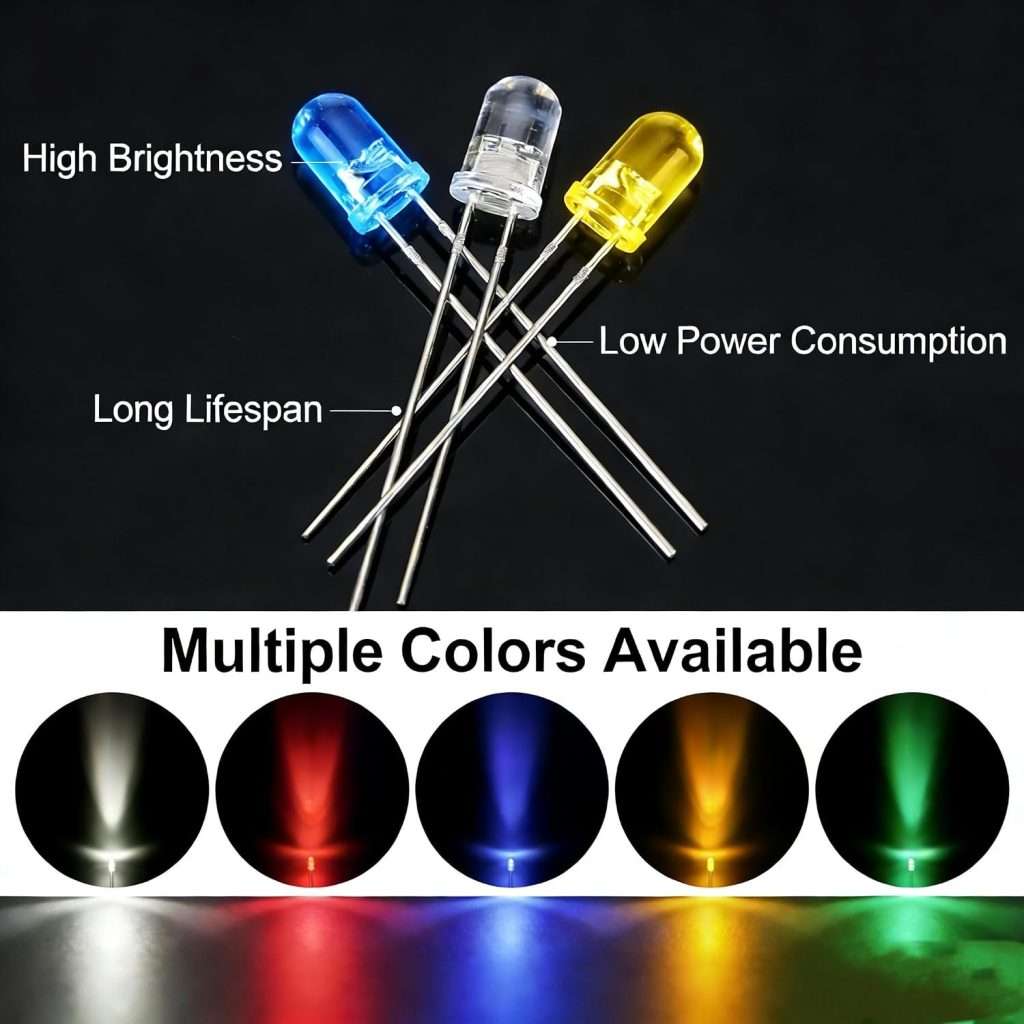
The most obvious advantage is the inclusion of five commonly used indicator colors: red, yellow, green, blue, and white. With 50 pieces of each color, the assortment provides a balanced component supply rather than heavily favoring a single color.
This makes the kit practical for circuits where different colors represent different states. For example, a red LED can indicate an error condition, yellow can represent a warning, green can indicate normal operation, while blue or white can provide additional status or illumination functions.
Standard 5mm Through-Hole Format
The 5mm package is particularly convenient for prototyping. Its leads can be inserted directly into breadboards, prototype PCBs, perfboards, and many educational electronics platforms.
The relatively large LED body also makes the light readily visible without requiring additional optics for many indicator applications.
Balanced 250-Piece Quantity
The 250-piece quantity provides a substantial component reserve for experimentation and repeated prototyping. With 50 pieces per color, users can build multiple circuits without immediately needing to replenish a particular color.
This is useful in educational environments where students may consume components during experiments, as well as in maker environments where circuits are frequently modified.
Different Forward-Voltage Groups
The kit also provides a useful practical demonstration of how LED color relates to electrical characteristics. Red and yellow devices are specified at approximately 2.0–2.2 V, whereas green, blue, and white devices are listed at approximately 3.0–3.2 V.
This difference makes the assortment useful for teaching basic LED circuit design, particularly current limiting and resistor selection.
Organized Storage
The product information indicates that the LEDs are organized in a clear plastic case, allowing different colors to be identified and accessed conveniently.
For a component assortment containing hundreds of small parts, organized storage can be particularly useful because it reduces the time required to identify individual components.

Application Scenarios
Arduino and Microcontroller Projects
These LEDs can be used as basic visual indicators for Arduino and other microcontroller-based projects. A GPIO output can control an LED through an appropriate current-limiting resistor, allowing firmware states to be represented visually.
For example, multiple LEDs can represent operating modes, sensor thresholds, communication status, or error conditions.
Breadboard Prototyping
The through-hole construction makes the LEDs suitable for breadboard experiments. Students can quickly construct circuits involving resistors, switches, transistors, logic gates, sensors, and microcontrollers.
The five-color assortment also makes it possible to construct multi-state demonstrations without purchasing several separate LED packages.
Educational Electronics
The kit is particularly suitable for introductory electronics education. Students can use the LEDs to learn about:
- Forward voltage
- Current limiting
- LED polarity
- Series circuits
- Parallel circuits
- Digital outputs
- PWM brightness control
- Basic semiconductor behavior
Because different colors have different listed forward-voltage ranges, the kit can also demonstrate why a resistor selected for one LED should not automatically be assumed appropriate for another color.
Robotics Projects
Robotic platforms frequently require multiple status indicators. Different colors can represent power, communications, sensor activity, battery status, movement states, or fault conditions.
The compact 5mm format makes these LEDs easy to mount on control boards, robot panels, or small enclosures.
Model Building and Crafts
The LEDs can also be integrated into scale models, custom enclosures, signs, miniature buildings, displays, and illuminated crafts. Their low-voltage operation allows them to be incorporated into small battery-powered or regulated electronic systems when the circuit is designed appropriately.
Indicator Panels
A group of LEDs can form a simple status panel. Because the kit provides five colors in equal quantities, designers can assign individual colors to different operating states while maintaining a consistent physical component size.
Competitive Analysis
Compared with purchasing individual bags of a single LED color, a five-color assortment provides greater variety in one package. The principal trade-off is that the quantity of each individual color is limited to 50 pieces.
| Characteristic | 250-Piece 5-Color Kit | Single-Color LED Pack | Specialized LED Assortment |
|---|---|---|---|
| Total LEDs | 250 | Varies | Varies |
| Color Variety | 5 colors | Usually 1 | Depends on assortment |
| 5mm Format | Yes | Depends on product | Depends on product |
| Quantity per Color | 50 | Usually higher for selected color | Depends on assortment |
| Forward Voltage Groups | Approximately 2.0–2.2 V and 3.0–3.2 V | Depends on LED | Depends on LED |
| Through-Hole Prototyping | Suitable | Usually suitable | Depends on package |
| Breadboard Use | Suitable | Suitable | Depends on package |
| Educational Use | Strong fit | Suitable | Depends on selection |
| High-Power Lighting | Not intended | Depends on component | Depends on component |
| Specialized Optical Requirements | Not specified | Depends on component | Depends on component |
The major strength of this kit is breadth rather than specialization. It provides five common colors in a single organized package, making it convenient for experimentation and general-purpose prototyping. The manufacturer/product listing specifically positions the kit toward hobbyists, students, DIY electronics, Arduino projects, robotics, model building, and related applications.
By contrast, a dedicated professional LED component may provide a substantially more detailed datasheet, including precise wavelength, luminous intensity, viewing angle, maximum ratings, and production tolerances. Those parameters are not sufficiently documented in the available listing for this assortment.
Similarly, a single-color bulk pack can be more appropriate when a production design requires hundreds or thousands of identical LEDs. The 50-piece-per-color distribution of this kit is more naturally suited to prototyping, educational work, repair, and small-batch projects.
Another important distinction is power capability. These are standard indicator-style 5mm LEDs, not high-power illumination devices. The published specification centers around approximately 20 mA operation, so applications requiring high luminous output or substantial illumination should use an appropriately specified high-power LED instead.
Design Considerations
When using the LEDs in an actual circuit, the most important consideration is current limiting. An LED should generally not be connected directly across a voltage source without appropriate current control.
The resistor value depends on the supply voltage, LED forward voltage, and desired current:
R = (VCC − VF) / IF
For a 5 V circuit, a red/yellow LED with approximately 2.0–2.2 V forward voltage has a larger voltage drop available for the resistor than a blue/green/white LED with approximately 3.0–3.2 V forward voltage.
For microcontroller applications, designers should also verify the GPIO pin’s voltage and current limits rather than assuming that the LED’s 20 mA specification means the microcontroller should always source 20 mA.
For applications involving many LEDs, multiplexing, transistor drivers, constant-current circuits, or dedicated LED-driver ICs can provide better control than directly driving every LED from GPIO pins.
The polarity should also be checked before installation. Like conventional LEDs, the component is polarized, with the anode and cathode requiring the correct orientation for normal forward operation.
Conclusion
The 250 Pcs 5mm LED Diodes Kit 5 Values 5 Color Light Assortment Kit is a versatile collection of standard 5mm through-hole LEDs intended primarily for electronics experimentation, prototyping, education, robotics, DIY projects, and low-power indicator applications.
Its principal characteristic is the balanced 250-piece, five-color configuration, providing 50 red, 50 yellow, 50 green, 50 blue, and 50 white LEDs. The assortment also exposes users to two useful forward-voltage groups: approximately 2.0–2.2 V for red/yellow and 3.0–3.2 V for green/blue/white, with the published operating/test reference of 20 mA.
For hobbyists, students, makers, and developers building prototypes, the combination of quantity, color variety, standard 5mm construction, and organized storage makes the kit convenient for maintaining a general-purpose LED component inventory.
Its limitations are equally important to recognize. The available product information does not establish detailed optical or maximum-rating specifications that would normally be required for demanding professional illumination designs. Therefore, projects requiring tightly controlled wavelength, luminous intensity, thermal performance, optical angle, or long-term production qualification should use LEDs with a manufacturer datasheet specifically covering those parameters.
Overall, this assortment is structured around variety and prototyping convenience rather than specialized LED performance. With five popular colors and 250 total components, it provides a practical foundation for breadboard experiments, microcontroller indicators, robotics, educational demonstrations, model lighting, and a wide range of small electronics projects.



