

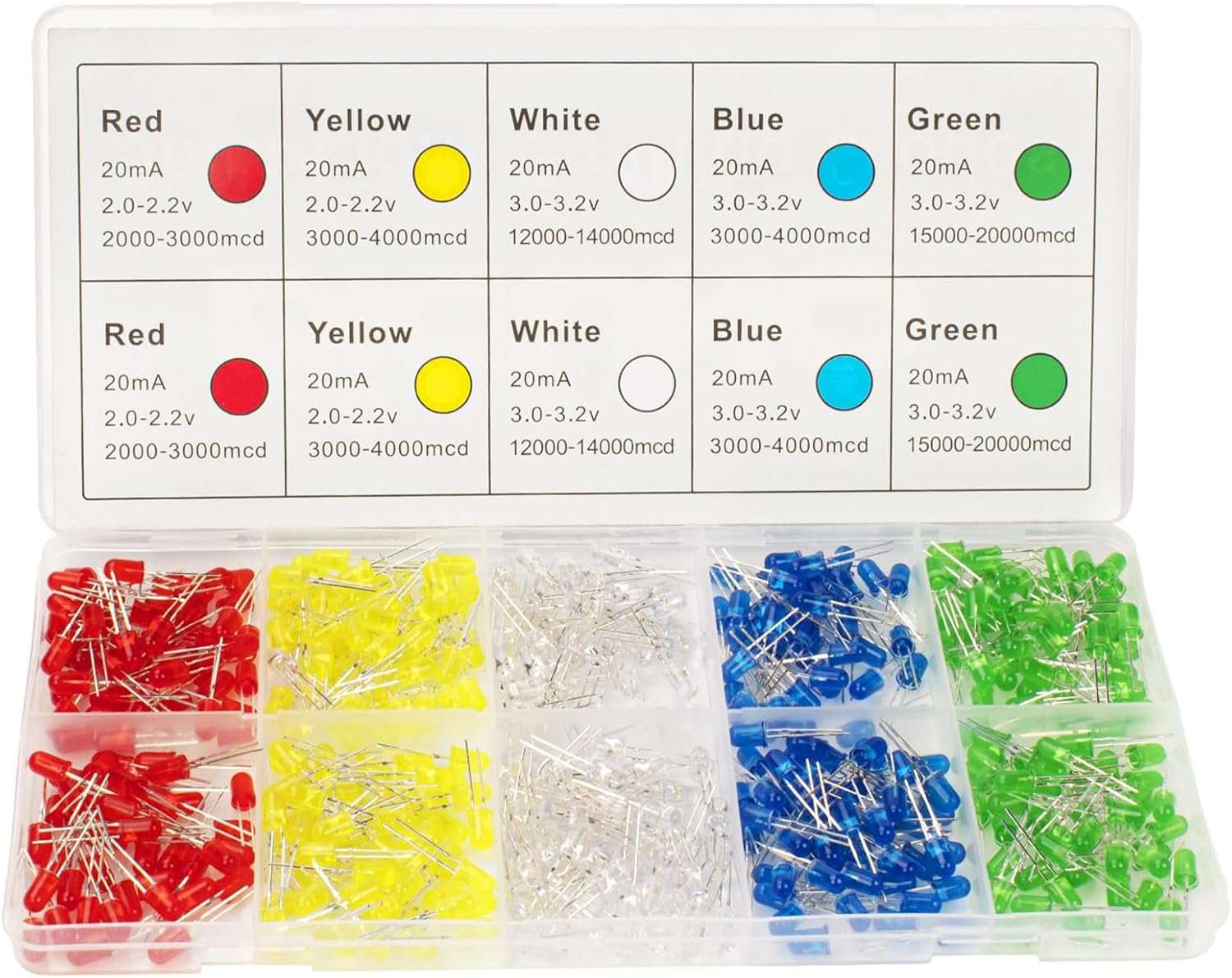

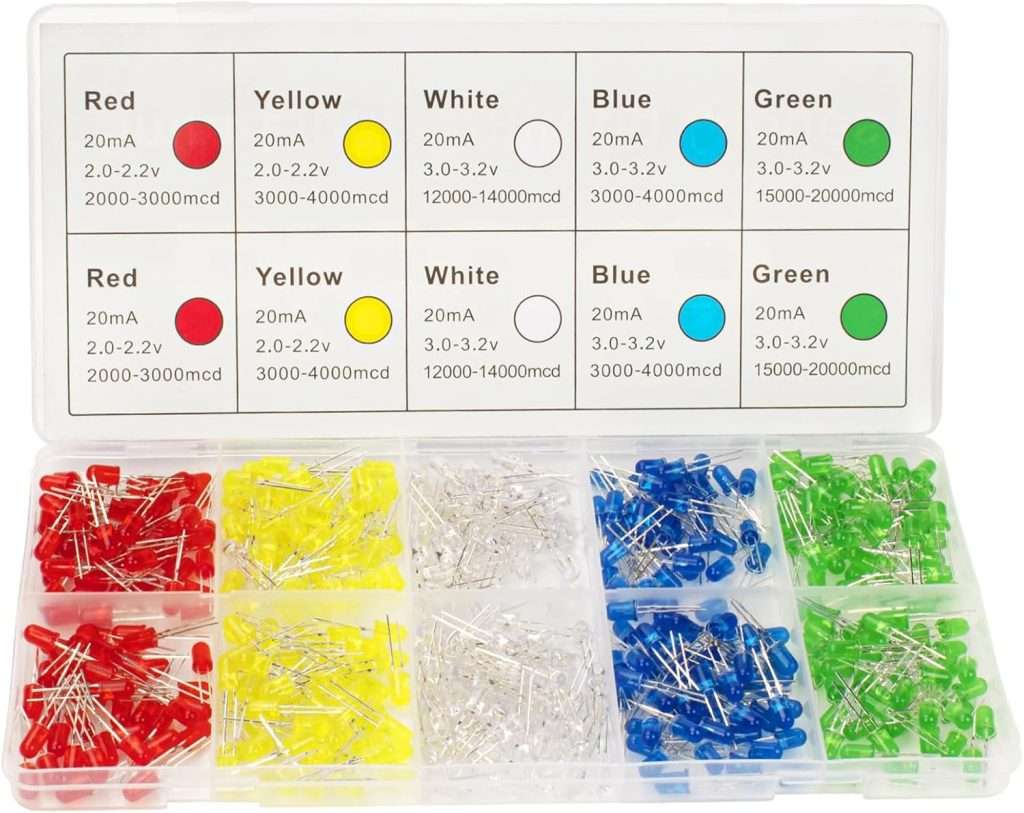
The 450pcs 5mm LED Diode, LED Light Kit Box 5 Colors, for DIY Project is a general-purpose through-hole LED assortment designed for electronics prototyping, indicator circuits, breadboard experiments, educational projects, and hobbyist lighting applications. The identified product is the DiCUNO 5C-5MM 450 L style assortment, containing 450 round-top 5 mm LEDs, divided into five colors with 90 pieces per color: red, yellow, green, blue, and white.
Rather than being a single electronic module, this product is a component inventory intended to give designers a convenient selection of visual indicators for repeated circuit development. Its value becomes particularly apparent during prototyping: instead of purchasing individual LED colors separately, the user has a ready supply of commonly used through-hole indicators in a compact storage box.
The LEDs use a conventional 5 mm round package and are suitable for breadboard insertion and through-hole PCB assembly. Product documentation specifies approximately 18 mm for the longer anode lead and 17 mm for the shorter cathode lead, providing a familiar polarity indication for assembly.
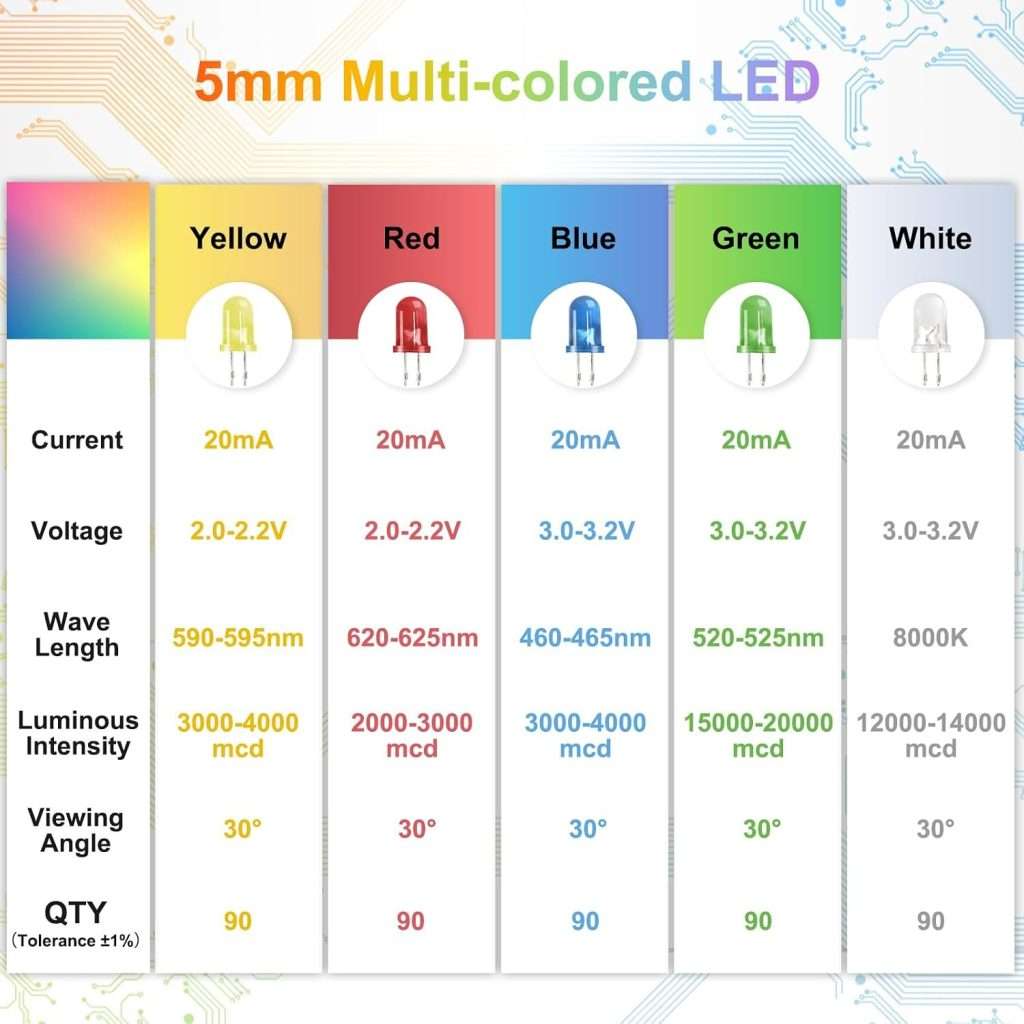
Electrical characteristics vary by LED color. The published product specifications identify approximately 2.0–2.2 V forward voltage for red and yellow devices, while blue, green, and white LEDs are specified at approximately 3.0–3.2 V. The maximum current is listed as 20 mA, and the viewing angle is approximately 30°.
These characteristics make the assortment particularly useful for simple status indicators, microcontroller projects, breadboard demonstrations, logic-state displays, alarm indicators, educational experiments, and decorative electronics. However, the LEDs should be operated with an appropriate current-limiting resistor or a suitable constant-current driver rather than being connected directly across a voltage source.
Technical Specifications
| Specification | Value |
|---|---|
| Product Type | 5 mm Through-Hole LED Assortment Kit |
| Product Model | DiCUNO 5C-5MM 450 L |
| Total Quantity | 450 LEDs |
| Number of Colors | 5 |
| Quantity per Color | 90 pcs |
| Colors | Red, Yellow, Green, Blue, White |
| LED Package | 5 mm Round Top |
| Mounting Type | Through-Hole |
| Maximum Forward Current | 20 mA |
| Red Forward Voltage | 2.0–2.2 V |
| Yellow Forward Voltage | 2.0–2.2 V |
| Green Forward Voltage | 3.0–3.2 V |
| Blue Forward Voltage | 3.0–3.2 V |
| White Forward Voltage | 3.0–3.2 V |
| Viewing Angle | 30° |
| Red Wavelength | 620–625 nm |
| Yellow Wavelength | 590–595 nm |
| Green Wavelength | 520–525 nm |
| Blue Wavelength | 460–465 nm |
| White Color Specification | 8000 K |
| Typical Package Diameter | 5 mm |
| Longer Lead | Approximately 18 mm, Anode |
| Shorter Lead | Approximately 17 mm, Cathode |
| Lens / Top Style | Round |
| Storage | Assorted Component Kit Box |
The published product information confirms the five-color, 90-pieces-per-color arrangement, 5 mm package, 20 mA maximum current, 30° viewing angle, color-specific forward-voltage ranges, wavelengths, and lead lengths.
Engineering note: the listed 20 mA value should be treated as the manufacturer’s maximum-current specification, not as a requirement to operate every LED at 20 mA. Actual operating current should be selected according to the desired brightness, circuit design, LED characteristics, and controller output limitations.
Key Features
1. Five Common LED Colors
The assortment contains red, yellow, green, blue, and white LEDs, with 90 pieces of each color. This makes the kit substantially more useful for general prototyping than an assortment containing only a single color.
The different colors can be assigned functional meanings within the same circuit. For example, red can represent an error or alarm condition, yellow can indicate a warning or intermediate state, green can indicate normal operation, while blue and white can be used for auxiliary status or illumination functions.
2. Standard 5 mm Through-Hole Format
The 5 mm round package is one of the most familiar LED formats in hobby electronics. It can be inserted directly into solderless breadboards, prototype PCBs, perfboards, and conventional through-hole PCB footprints.
The approximately 18 mm/17 mm lead lengths also make the devices convenient for manual assembly. The longer lead identifies the anode and the shorter lead identifies the cathode, simplifying polarity identification during prototyping.
3. Different Forward-Voltage Characteristics
One important technical characteristic is the difference between LED colors. The specified forward voltage is approximately 2.0–2.2 V for red and yellow, compared with approximately 3.0–3.2 V for blue, green, and white.
This difference matters when selecting current-limiting resistors.
For example, with a 5 V supply and a nominal 10 mA target current, a red LED with approximately 2.1 V forward voltage would require roughly:
R = (5 − 2.1) / 0.01 ≈ 290 Ω
A practical 300 Ω resistor would therefore be a reasonable starting point.
For a white LED with approximately 3.1 V forward voltage:
R = (5 − 3.1) / 0.01 ≈ 190 Ω
A practical 200 Ω resistor would be a corresponding starting point.
These are illustrative calculations rather than guaranteed operating values; actual LED forward voltage varies with current and individual device characteristics.
4. Focused 30° Viewing Angle
The published specification gives the LEDs a 30° viewing angle.
Compared with a very wide-angle indicator, a 30° package concentrates the visible output into a narrower field. This can be useful when the LED is positioned behind a front-panel indicator hole or used as a directional status indicator.
It is also helpful for demonstrations where the designer wants the light to be visually noticeable from the front rather than distributed broadly across a surrounding surface.
5. Color-Specific Optical Characteristics
The published wavelength information provides useful differentiation between the colors: red is specified around 620–625 nm, yellow around 590–595 nm, green around 520–525 nm, and blue around 460–465 nm. White is specified by a color temperature of approximately 8000 K rather than a single dominant wavelength.
This makes the kit useful not only for simple on/off indicators but also for experiments involving optical color recognition, PWM brightness control, light-sensing circuits, and human-machine interfaces.
Application Scenarios
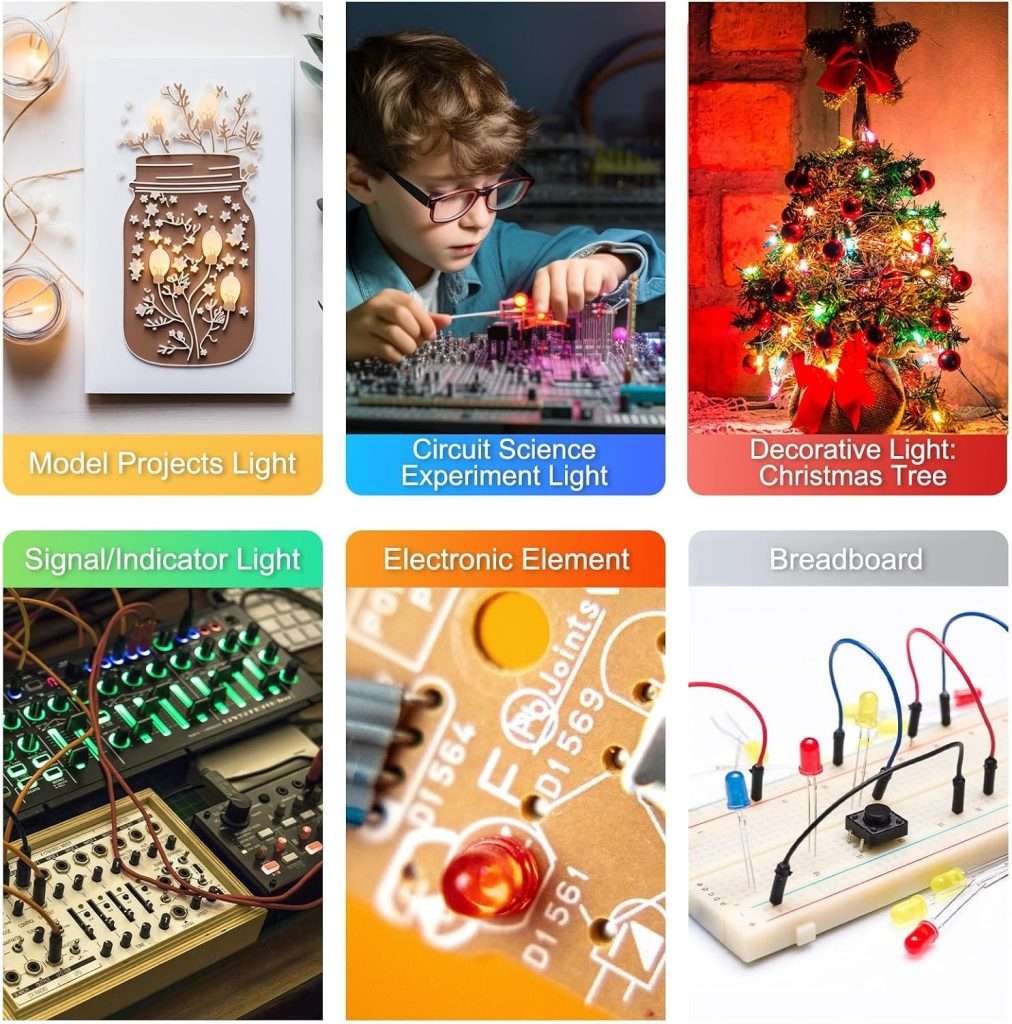
Breadboard Prototyping
The most direct application is breadboard-based electronics development. A microcontroller such as an Arduino-compatible board, STM32 development board, Raspberry Pi accessory circuit, or other embedded controller can drive individual LEDs through GPIO pins.
The five colors allow a prototype to display multiple operating states simultaneously. For example, a development board could use green for normal operation, yellow for a warning, red for an error, blue for communication activity, and white for a general-purpose indicator.
Microcontroller Experiments
The LEDs are particularly useful for learning GPIO control, PWM, timers, interrupts, and digital state visualization.
A beginner can start with a simple GPIO output circuit and progress toward PWM-controlled brightness, multi-color sequences, reaction-time games, traffic-light simulations, and sensor-status displays.
Educational Electronics
Because the LEDs are inexpensive individual components rather than an integrated module, they are suitable for classroom demonstrations of fundamental electronics principles.
Students can investigate:
- LED polarity
- Forward voltage
- Current limiting
- Ohm’s law
- Digital output states
- PWM
- Color-dependent electrical behavior
- Series and parallel circuits
- Basic transistor switching
The different forward-voltage ranges provide a particularly useful practical demonstration of why LEDs of different colors cannot necessarily be treated as electrically identical devices.
Signal and Status Indicators
The 5 mm package is well suited to control panels and prototypes requiring visible status indication.
A small embedded system could use individual LEDs to indicate power, communications, sensor activity, fault status, battery state, or operating modes. The relatively narrow 30° viewing angle can also work well with front-panel indicator openings.
Automotive and Vehicle DIY Projects
Product listings specifically identify automotive decoration among the intended application areas.
For automotive electronics, however, the LEDs should not be connected directly to a vehicle supply. Automotive electrical systems can experience voltage variation and transient conditions, so suitable resistive or constant-current drive circuitry and appropriate protection should be incorporated.
Electronic Art and Decorative Projects
The five colors make the kit useful for illuminated models, custom signs, miniature displays, interactive artwork, and decorative electronics.
Because each LED is independently controllable, designers can create patterns and sequences without requiring a dedicated RGB LED module.
Competitive Analysis
The most relevant alternatives are other 5 mm assorted LED component kits, rather than functional electronic modules.
Single-Color LED Packs
A single-color 5 mm LED pack can provide greater quantity of one particular color and may be preferable for production work requiring hundreds of identical indicators.
However, a five-color assortment offers greater flexibility during experimentation. For makers, educators, and prototyping engineers who regularly need different indicator colors, having all five colors in one kit reduces the need to maintain multiple separate component inventories.
10-Color Assorted LED Kits
Some competing kits provide ten or more colors. This can provide a broader visual palette, sometimes including orange, pink, ultraviolet, warm white, or other variants.
The trade-off is quantity per color. A five-color kit with 90 pieces per color provides a comparatively deep inventory of its selected colors, making it better suited to repeated projects using conventional red/yellow/green/blue/white indicators.
LED Assortments With Resistors
Another category combines LEDs and current-limiting resistors in one kit. Such a package can be convenient for beginners because the resistor-selection step is simplified.
The separate LED assortment has a different advantage: the user can select resistance values according to the actual supply voltage, desired current, and LED forward voltage. This is more flexible for engineering experiments and embedded-system development.
Preassembled LED Modules
Preassembled LED modules generally offer easier wiring because the resistor and sometimes the connector are already integrated.
However, an individual through-hole LED provides substantially greater freedom in physical placement and circuit architecture. It can be connected directly to a breadboard, mounted individually on a PCB, or combined with transistors, MOSFETs, logic gates, and microcontroller outputs.



