

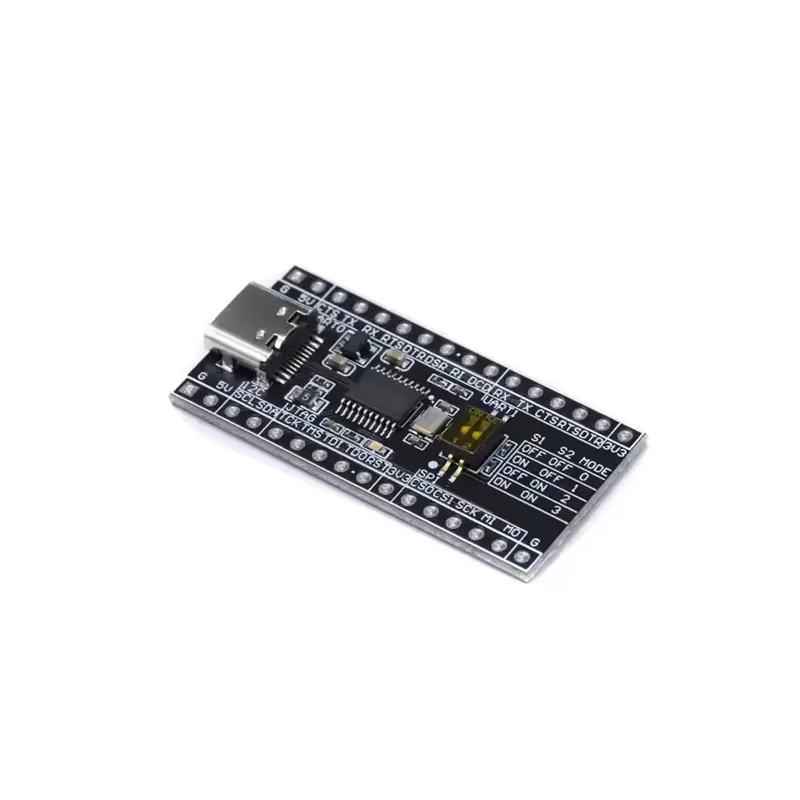

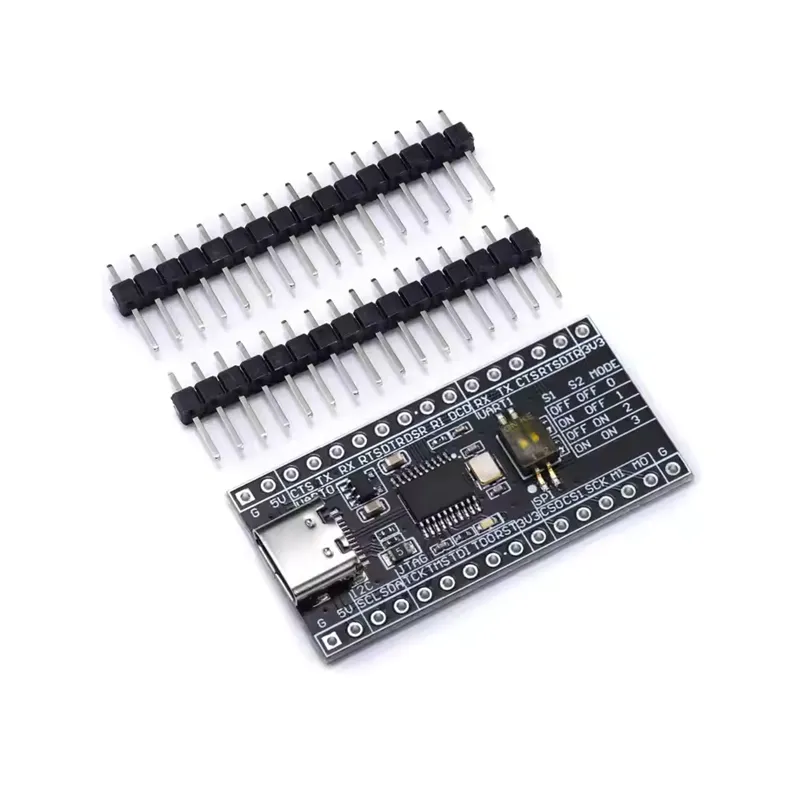
The Module-14006 CH347 Development Board is a versatile USB interface development platform built around the WCH CH347 high-speed USB bridge controller. Designed to simplify communication between a host computer and a wide range of peripheral devices, the board integrates multiple hardware communication interfaces—including SPI, I²C, UART, JTAG, and GPIO—into a single compact solution. This flexibility makes it an invaluable tool for embedded system developers, hardware engineers, firmware programmers, educational institutions, and electronics enthusiasts.
Unlike conventional USB-to-serial adapters that provide only a single communication interface, the CH347 development board combines several industry-standard protocols on one platform. Developers can prototype, debug, program, and evaluate hardware without requiring multiple dedicated adapters, significantly reducing development costs and improving workflow efficiency.
The CH347 controller complies with the USB 2.0 High-Speed specification (480 Mbps), providing substantially higher bandwidth than traditional Full-Speed USB bridge solutions. This high-speed connection allows rapid data transfers when communicating with SPI flash memories, EEPROMs, sensors, displays, programmable logic devices, and various embedded controllers.
The Module-14006 development board is particularly well suited for firmware development, peripheral testing, hardware verification, industrial automation, laboratory instrumentation, and educational projects. Engineers can use it to access SPI flash devices, configure I²C sensors, communicate with UART-enabled microcontrollers, perform JTAG debugging, or utilize programmable GPIO lines for custom control applications.
Because the board is supported by WCH’s official software libraries and driver packages, software integration is relatively straightforward on Windows and other supported operating systems. Developers can quickly build applications using the supplied APIs or integrate the board into existing development environments.
Overall, the Module-14006 CH347 Development Board serves as a highly integrated USB communication platform that bridges modern computers with embedded hardware, making it an efficient and flexible solution for both professional development and advanced hobbyist projects.
Technical Specifications
| Specification | Details |
| Product Name | Module-14006 CH347 Development Board |
| Main Controller | WCH CH347 |
| USB Standard | USB 2.0 High-Speed |
| Maximum USB Speed | 480 Mbps |
| USB Connector | USB Type-C or Micro-USB (board revision dependent) |
| Communication Interfaces | SPI, I²C, UART, JTAG, GPIO |
| UART Support | Full-duplex asynchronous serial communication |
| SPI Modes | Master mode supported by CH347 |
| I²C Modes | Master mode supported by CH347 |
| GPIO | Multiple programmable GPIO pins |
| JTAG Support | Yes |
| Driver Support | Official WCH drivers |
| Software Support | WCH SDK and API |
| Operating Voltage | 5 V via USB |
| Logic Voltage | 3.3 V (board dependent) |
| Operating Temperature | Commercial operating range (board dependent) |
| PCB Type | Multi-layer PCB |
| Development Support | Windows SDK and programming examples |
| Primary Applications | Embedded development, debugging, programming, industrial communication |
Key Features
One of the most significant strengths of the Module-14006 CH347 Development Board is its exceptional interface integration. Instead of requiring separate USB adapters for UART, SPI, I²C, and JTAG communication, the CH347 combines these commonly used interfaces into one controller, reducing hardware complexity while improving portability.
USB 2.0 High-Speed Connectivity
The board utilizes the CH347’s USB 2.0 High-Speed interface, capable of operating at up to 480 Mbps. Compared with traditional USB Full-Speed interface chips, the increased bandwidth significantly improves communication efficiency when transferring firmware images, reading flash memory contents, or communicating with high-speed peripherals.
SPI Master Interface
The integrated SPI controller enables communication with numerous SPI-compatible devices, including:
- SPI NOR Flash memory
- EEPROM
- ADCs
- DACs
- TFT display controllers
- FPGA configuration memories
- Digital sensors
High-speed SPI transfers make firmware programming and data acquisition considerably faster than lower-bandwidth alternatives.
I²C Master Interface
The I²C interface allows engineers to communicate with numerous low-speed digital devices commonly found in embedded systems, such as:
- Environmental sensors
- EEPROM devices
- Real-time clocks
- GPIO expanders
- OLED displays
- Power management ICs
Developers can easily evaluate peripheral devices or configure embedded hardware using standard I²C transactions.
UART Communication
UART remains one of the most widely used debugging and communication interfaces in embedded development. The CH347 provides reliable USB-to-UART conversion suitable for:
- Bootloader communication
- Console logging
- Firmware debugging
- Industrial equipment
- Embedded Linux systems
- Microcontroller development
Because UART is universally supported across nearly all microcontroller families, this interface greatly enhances the board’s versatility.
Integrated JTAG Support
For developers working with programmable logic devices or supported debugging workflows, the integrated JTAG functionality eliminates the need for an additional programming adapter in many development scenarios.
Programmable GPIO
The available GPIO pins can be configured for general digital input or output applications. These pins allow developers to:
- Toggle relays
- Control LEDs
- Read switches
- Generate digital signals
- Interface with custom hardware
GPIO functionality greatly expands the board’s usefulness beyond protocol communication.
Mature Software Ecosystem
WCH provides drivers, software libraries, API documentation, and programming examples that simplify application development. Developers can integrate the board into custom software without having to implement low-level USB communication from scratch.
Compact Development Platform
The board’s compact size allows it to be easily integrated into desktop development environments, laboratory benches, production programming fixtures, or portable debugging kits.
Application Scenarios
The flexibility of the Module-14006 CH347 Development Board enables it to serve a broad range of engineering applications.
Embedded System Development
Firmware engineers frequently require access to multiple communication protocols while developing new embedded products. The CH347 board provides a single hardware platform capable of interacting with microcontrollers through UART, configuring peripherals via I²C, and programming external flash devices using SPI.
SPI Flash Programming
External SPI NOR Flash memories are widely used for firmware storage. Engineers can use the board to:
- Read firmware
- Write firmware
- Verify programmed images
- Backup flash contents
- Recover corrupted firmware
Its USB High-Speed interface significantly accelerates these operations.
Sensor Evaluation
Modern embedded systems often incorporate multiple I²C sensors. Developers can rapidly evaluate temperature sensors, accelerometers, pressure sensors, humidity sensors, and other digital peripherals without designing dedicated interface hardware.
Hardware Debugging
During prototype development, engineers frequently need simultaneous access to UART logs, GPIO control, and SPI communication. The CH347 development board consolidates these capabilities into a single USB device, simplifying debugging workflows.
Industrial Automation
Industrial control systems often require reliable communication between PCs and embedded controllers. The board can function as a flexible communication interface for configuration, diagnostics, firmware updates, and equipment testing.
Manufacturing and Production Testing
Production engineers can integrate the Module-14006 board into automated test fixtures where firmware programming, hardware verification, and communication testing must be performed efficiently.
Educational Laboratories
Universities and technical training institutions benefit from hardware platforms that expose students to multiple communication protocols. Rather than purchasing several interface adapters, instructors can use a single CH347 board to demonstrate UART, SPI, I²C, GPIO, and JTAG concepts.
Hobbyist Electronics
Advanced electronics enthusiasts can use the board for Arduino-compatible peripherals, Raspberry Pi accessories, EEPROM programming, display testing, and custom embedded projects without investing in multiple USB adapters.
Competitive Analysis
The Module-14006 CH347 Development Board occupies an attractive position among multifunction USB communication adapters. Its primary competitors include FTDI-based USB bridges, Silicon Labs USB interface devices, and individual protocol-specific programmers.
Advantages
Multiple Interfaces in One Device
Many competing USB bridge solutions focus primarily on UART communication. The CH347 integrates SPI, I²C, UART, GPIO, and JTAG support into one controller, reducing equipment requirements.
USB 2.0 High-Speed
With support for USB 2.0 High-Speed operation, the CH347 offers substantially higher theoretical bandwidth than many legacy USB bridge ICs limited to Full-Speed USB operation.
Reduced Development Cost
Purchasing separate SPI programmers, UART adapters, I²C interfaces, and GPIO controllers can become expensive. The Module-14006 consolidates these capabilities, offering better overall value for engineers requiring multiple interfaces.
Simplified Workspace
Instead of connecting several USB adapters simultaneously, developers can perform numerous tasks using one compact development board, reducing cable clutter and improving workflow.
Potential Limitations
Although highly versatile, the Module-14006 may not completely replace specialized professional programming tools designed for particular microcontroller families. Vendor-specific debugging probes often provide advanced debugging capabilities such as hardware breakpoints, real-time trace, and integrated IDE support beyond the scope of a general-purpose USB bridge.
Similarly, while the CH347 supports JTAG functionality, compatibility depends on software support and target hardware requirements. Developers working with specialized debugging environments should verify compatibility before deployment.
Finally, board implementations may differ slightly between manufacturers regarding connector type, voltage configuration, GPIO availability, and auxiliary circuitry. Reviewing the specific Module-14006 hardware documentation is recommended before integrating the board into production systems.
Despite these considerations, the Module-14006 remains one of the most flexible and cost-effective multifunction USB interface development boards available for general embedded development.
Conclusion
The Module-14006 CH347 Development Board successfully combines multiple essential communication interfaces into a compact and efficient USB development platform. Powered by the WCH CH347 controller, it offers USB 2.0 High-Speed connectivity alongside SPI, I²C, UART, GPIO, and JTAG functionality, making it suitable for a broad spectrum of embedded engineering tasks.
Its greatest advantage lies in reducing hardware complexity by replacing multiple dedicated adapters with a single multifunction device. Whether programming SPI flash memories, debugging embedded firmware, evaluating digital sensors, controlling GPIO devices, or communicating with industrial equipment, the board delivers impressive flexibility and convenience.
Official software support, mature drivers, and readily available development resources further enhance its appeal, allowing engineers to integrate the board into existing workflows with minimal effort. Educational users also benefit from its ability to demonstrate multiple communication protocols on one platform, making it a practical teaching tool for embedded systems and digital electronics.
Although specialized debugging probes may still be preferable for vendor-specific development environments requiring advanced debugging capabilities, the Module-14006 excels as a general-purpose USB communication bridge that covers the majority of common development and testing requirements.
For professionals seeking a reliable multifunction interface solution, educators requiring a versatile laboratory platform, or electronics enthusiasts building increasingly sophisticated projects, the Module-14006 CH347 Development Board offers an excellent balance of functionality, performance, integration, and value. Its combination of high-speed USB communication, broad protocol support, and compact design makes it a dependable addition to virtually any embedded development toolkit.



