


Overview
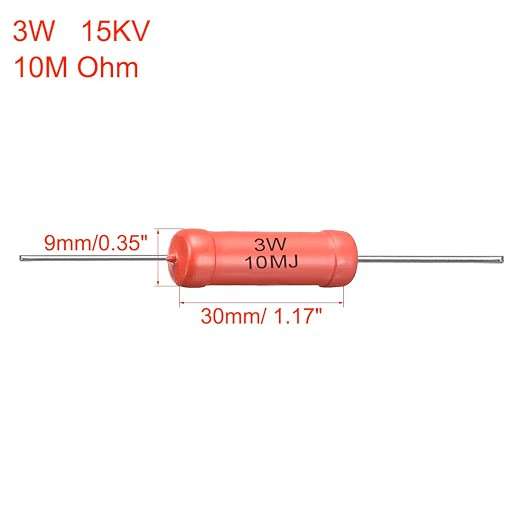
In ordinary electronic circuits, resistors are often selected primarily according to resistance, tolerance, and power dissipation. Once circuit voltages rise into the kilovolt range, however, resistor selection becomes considerably more demanding. A component must not only provide the required resistance and power rating but also withstand substantial electrical stress across its body and terminals without insulation failure, surface flashover, or excessive thermal loading.
The 3W Power Rating 10MΩ High-Voltage Glass-Glaze Film Resistor is designed for precisely this type of environment. With a nominal resistance of 10 MΩ and a 3 W power rating, the resistor occupies a very different category from ordinary quarter-watt carbon or metal-film components. Its approximately 30 mm × 9 mm cylindrical body provides considerably more physical scale than a conventional small-signal resistor, while the glass-glaze construction is intended for high-voltage applications requiring insulation and thermal durability. The accessible product information identifies the component as a high-voltage glass-glaze film resistor and specifies a ±2% resistance tolerance.
The 10 MΩ resistance is particularly useful when a circuit needs to limit current while working with high potential differences. According to Ohm’s law, a 10 MΩ resistor connected across 1 kV would theoretically conduct only 100 µA, while the corresponding dissipation would be 0.1 W. At 5 kV, the current becomes 500 µA and power dissipation rises to 2.5 W. This simple relationship demonstrates why a high-resistance, higher-power component can be valuable in high-voltage measurement and control circuits.
At the same time, the distinction between resistance, power rating, and voltage rating is critical. A 3 W resistor does not automatically mean that it can continuously dissipate 3 W at any voltage up to a stated kilovolt value. For a 10 MΩ resistance, 3 W corresponds mathematically to approximately 5.48 kV RMS/DC equivalent across the resistor when power is calculated using P=V2/RP=V^2/R. Consequently, a claimed 15 kV rating must be interpreted according to the manufacturer’s actual working-voltage, dielectric-strength, pulse, and derating specifications rather than assuming 15 kV operation at the full 3 W rating.
The product information identifies several intended application areas, including impulse voltage generators, arc-furnace damping, energy research, pulse modulators, capacitor crowbar circuits, high-voltage snubber circuits, and EMI/lightning suppression. These applications share a common requirement: the resistor must provide a large electrical resistance while maintaining physical robustness under elevated electrical stress.
For professional engineers, the resistor can therefore serve as a building block within carefully engineered high-voltage networks. For electronics experimenters, it provides an accessible way to construct high-resistance voltage dividers, controlled discharge paths, and experimental high-voltage circuits. However, high-voltage construction requires appropriate creepage, clearance, insulation, enclosure, grounding, and discharge provisions; the resistor itself should never be treated as a complete safety barrier.
Technical Specifications
The following table separates specifications directly identified by available product information from the 15 kV designation in the requested product name.
| Parameter | Specification |
|---|---|
| Product Type | High-voltage glass-glaze film resistor |
| Resistance | 10 MΩ |
| Power Rating | 3 W |
| Resistance Tolerance | ±2% |
| Resistor Construction | Glass-glaze film |
| Body Dimensions | Approximately 30 mm × 9 mm |
| Lead Dimensions | Approximately 26 mm × 1 mm |
| Lead Configuration | Axial, through-hole |
| Package Quantity | 2 pieces in the referenced product listing |
| Manufacturer/Brand | uxcell |
| Model / Item Number | a19012500ux0078 |
| Product Identifier | B07QL8XWTK |
| Stated Application Areas | Impulse voltage generators, arc-furnace damping, energy research, pulse modulators, capacitor crowbar circuits, high-voltage snubbers, EMI/lightning suppression |
| Nominal Voltage Designation | 15 kV as specified in the requested product description; continuous working-voltage verification is not established by the accessible product listing |
| Mounting | Through-hole axial |
| Form Factor | Cylindrical axial resistor |
The product listing explicitly gives the 3 W power rating, 10 MΩ resistance, ±2% tolerance, 30 × 9 mm body, and 26 × 1 mm lead dimensions.
Key Features
10 MΩ Resistance for High-Voltage Current Limiting
The defining electrical characteristic is its 10 MΩ resistance. Such a high resistance allows engineers to work with substantial voltage differences while keeping current relatively low.
For example:
- At 1 kV: approximately 100 µA
- At 2 kV: approximately 200 µA
- At 5 kV: approximately 500 µA
- At 10 kV: approximately 1 mA
These values follow the ideal relationship I=V/RI=V/R, assuming the resistor remains within its applicable electrical and thermal limits.
This makes a 10 MΩ component particularly useful for voltage-sensing networks, leakage-current paths, controlled discharge circuits, and high-voltage bias arrangements.
3 W Power Capability
The 3 W rating gives the component substantially greater power-handling capability than typical small signal resistors.
The relationship between voltage, resistance, and power is especially important for this component:P=V2RP=\frac{V^2}{R}
With R=10 MΩR=10\,MΩ, a 3 W dissipation corresponds to:V=3×10,000,000≈5.48 kVV=\sqrt{3\times10,000,000}\approx5.48\,kV
This calculation illustrates an important engineering principle: power rating and voltage rating are separate specifications.
A resistor may be physically capable of withstanding a high voltage while its allowable continuous power dissipation requires derating. Conversely, a resistor may be capable of dissipating several watts at a lower voltage but not withstand the same voltage when applied across its terminals because of dielectric or surface-flashover limitations.
Therefore, engineers should consult the applicable manufacturer’s voltage and derating specifications before using the component in a 15 kV circuit.
Glass-Glaze Construction
The glass-glaze construction is an important physical characteristic.
High-voltage resistors must address electrical insulation and environmental durability in addition to resistance stability. The protective glaze forms a robust external coating around the resistive element, helping isolate the internal resistive structure from the surrounding environment.
The product description specifically associates the glass-glaze construction with durability and heat resistance.
This construction is particularly relevant in applications involving elevated voltage, pulses, and electrical transients.
±2% Resistance Tolerance
The specified ±2% tolerance means that the nominal 10 MΩ resistance is specified within a 2% tolerance band under the manufacturer’s applicable measurement conditions.
The corresponding nominal range is approximately:
9.8 MΩ to 10.2 MΩ
For many current-limiting and damping applications, this is sufficiently precise. However, high-precision measurement systems may require tighter-tolerance high-voltage resistors or calibrated resistor networks.
Large Axial Body
The approximately 30 mm × 9 mm body is significantly larger than ordinary low-power axial resistors. The physical size is not merely cosmetic; high-voltage resistors often require additional physical dimensions to manage insulation, thermal dissipation, and electrical field distribution.
The product listing specifies approximately 30 mm body length and 9 mm diameter, with leads approximately 26 mm long and 1 mm in diameter.
This construction also makes the component straightforward to install on experimental or custom through-hole PCBs.
Low-Noise High-Resistance Construction
The product listing describes the resistor as high precision and low noise, characteristics that can be useful when the component participates in sensitive measurement or control circuits.
Nevertheless, “low noise” should not be interpreted as a quantified noise-performance specification unless a manufacturer datasheet provides numerical noise data. For precision instrumentation, designers should evaluate voltage coefficient, temperature coefficient, excess noise, long-term stability, and frequency-dependent behavior where these parameters are important.
Application Scenarios
High-Voltage Voltage Dividers
One of the most natural applications is a high-voltage voltage-divider network.
A 10 MΩ resistor can be combined with another precision resistor or resistor string to reduce a high voltage to a level suitable for measurement circuitry.
For example, several high-value resistors can be connected in series so that the total resistance and voltage distribution are shared among multiple components.
This approach can reduce the electrical stress imposed on any individual resistor, provided the resistor voltage ratings, power ratings, physical spacing, and environmental conditions are properly considered.
High-Voltage Snubber Networks
The product listing specifically identifies high-voltage snubber circuits as an application.
A resistor used in a snubber network can help control transient energy and damping behavior when combined with capacitors or other circuit elements.
In high-voltage switching equipment, this can be important because parasitic inductance and capacitance can generate substantial voltage overshoot when switching occurs.
The 10 MΩ value is particularly suited to applications where only a small current is intended to flow through the resistive path.
Pulse Modulators and Impulse Voltage Generators
Pulse-generating equipment can expose components to short-duration, high-amplitude electrical transients.
The manufacturer listing identifies pulse modulators and impulse voltage generators among the intended applications.
In these systems, engineers must distinguish between steady-state power capability and pulse-energy capability. A resistor’s suitability for a particular pulse depends on pulse duration, repetition rate, waveform, peak voltage, thermal recovery, and construction.
Therefore, a 3 W continuous rating alone cannot be used to determine the maximum safe pulse energy.
Capacitor Crowbar Circuits
Capacitor crowbar systems intentionally provide a rapid discharge path under particular fault or triggering conditions.
A high-value resistor may be incorporated into such a system for controlled charging, leakage management, or other auxiliary functions.
Because capacitor banks can retain dangerous energy after power has been removed, appropriate discharge and safety circuitry is essential.
EMI and Lightning Suppression
The product listing also identifies EMI/lightning suppression as an application.
High-voltage resistors can participate in networks designed to control transient voltages and unwanted electrical energy.
However, lightning-related circuits involve extremely high transient energies and current impulses. A resistor’s suitability must therefore be established from pulse and surge specifications rather than inferred from its nominal 3 W rating.
Energy Research and Laboratory Equipment
Laboratory equipment used for high-voltage research often requires high-value resistors for:
- Voltage measurement
- Controlled discharge
- Bias networks
- Damping
- Experimental energy circuits
The relatively large axial body makes this type of resistor practical for custom laboratory assemblies where physical size is less restrictive than in densely packed consumer electronics.
Competitive Analysis
Compared with Conventional 3 W Metal-Oxide Film Resistors
Standard 3 W metal-oxide film resistors are readily available and can offer good thermal performance at ordinary circuit voltages.
Their strengths include:
- Broad availability
- Familiar construction
- Good general-purpose performance
- Convenient PCB mounting
Their limitation in this application is that ordinary 3 W resistors are generally specified around much lower working voltages than dedicated high-voltage resistor constructions.
A high-voltage glass-glaze resistor is therefore physically and electrically oriented toward a different class of application.
Compared with Vishay High-Voltage Axial Resistors
Manufacturers such as Vishay offer dedicated high-voltage resistor families with published electrical characteristics and application-specific specifications. For example, current distributor listings include Vishay high-voltage axial resistors in values around 10 MΩ with defined voltage ratings.
The major advantage of established precision high-voltage families is the availability of detailed engineering data, which can include voltage coefficient, temperature coefficient, stability, dielectric characteristics, and defined working-voltage limits.
The glass-glaze component considered here has the advantage of straightforward construction and availability for experimental applications, but engineers requiring certified, tightly controlled performance may need a resistor family with a comprehensive manufacturer datasheet.
Compared with Series-Connected Standard Resistors
Another approach is to place several ordinary resistors in series.
This can distribute:
- Total voltage
- Power dissipation
- Electrical field stress
However, a series string requires careful calculation of each resistor’s voltage and power loading, as well as adequate spacing and protection.
A purpose-built high-voltage resistor simplifies the physical design by providing a component specifically intended for elevated electrical stress.
Compared with Wirewound High-Voltage Resistors
Wirewound resistors can provide high power ratings and excellent thermal characteristics. However, their construction can introduce inductance, which may become undesirable in fast transient or pulse circuits.
The product information identifies the subject component as a glass-glaze film resistor rather than a conventional wirewound resistor.
For high-frequency or fast-pulse applications, engineers should therefore consider the resistor’s parasitic inductance and frequency response rather than selecting purely according to resistance and wattage.
Conclusion
The 3W Power Rating 10MΩ High-Voltage Glass-Glaze Film Resistor is a specialized through-hole component intended for applications where ordinary resistors are inadequate because of high electrical stress. Its combination of 10 MΩ resistance, 3 W power rating, ±2% tolerance, and approximately 30 × 9 mm glass-glaze body gives it a useful role in high-voltage experimental and industrial circuits.
Its 10 MΩ resistance makes it particularly useful for limiting current in high-voltage systems, while the 3 W power rating provides substantially more thermal capacity than common low-power resistors. The glass-glaze construction and relatively large physical dimensions further reflect the requirements of high-voltage component design.
The component’s listed applications—including impulse voltage generators, pulse modulators, capacitor crowbar circuits, high-voltage snubbers, arc-furnace damping, energy research, and EMI/lightning suppression—demonstrate the breadth of situations in which high-value, high-voltage resistance is useful.
However, responsible engineering requires a clear distinction between the 15 kV designation in the product description and a verified continuous working-voltage specification. The accessible product information confirms the 10 MΩ and 3 W ratings but does not provide sufficient manufacturer data to establish that 15 kV can be applied continuously at full rated power. In fact, the basic P=V2/RP=V^2/R relationship shows that 15 kV across 10 MΩ would correspond to 22.5 W, far above the stated 3 W power rating. Consequently, the component must be selected and derated according to the actual voltage, power, pulse duration, duty cycle, thermal conditions, and manufacturer’s applicable high-voltage specifications.
Used within those constraints, this resistor provides a practical and economical building block for high-voltage circuitry. Its high resistance, substantial physical size, axial construction, and glass-glaze protective structure make it particularly appropriate for experimental equipment, high-voltage measurement networks, damping circuits, and other applications where electrical stress is a fundamental design consideration.



