

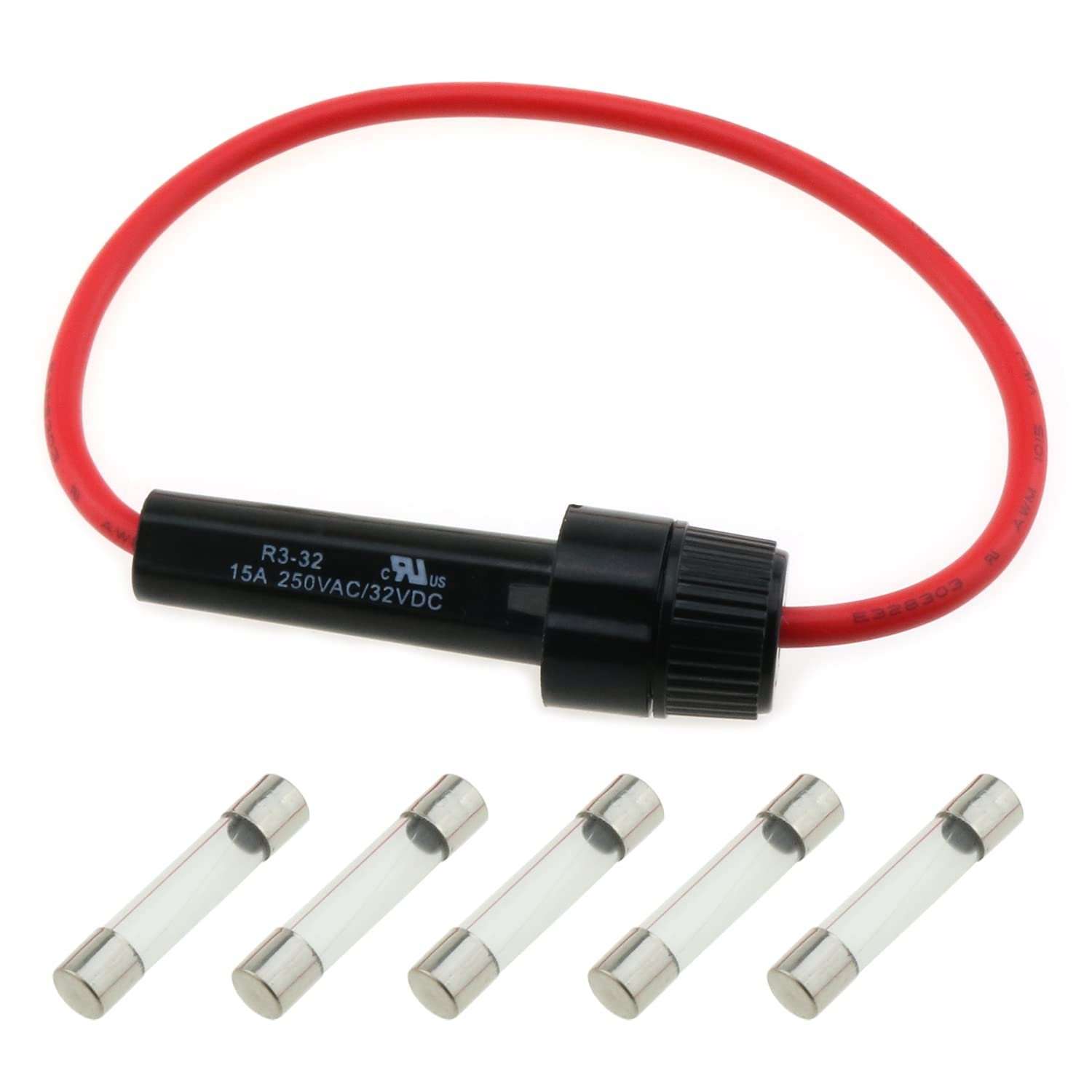

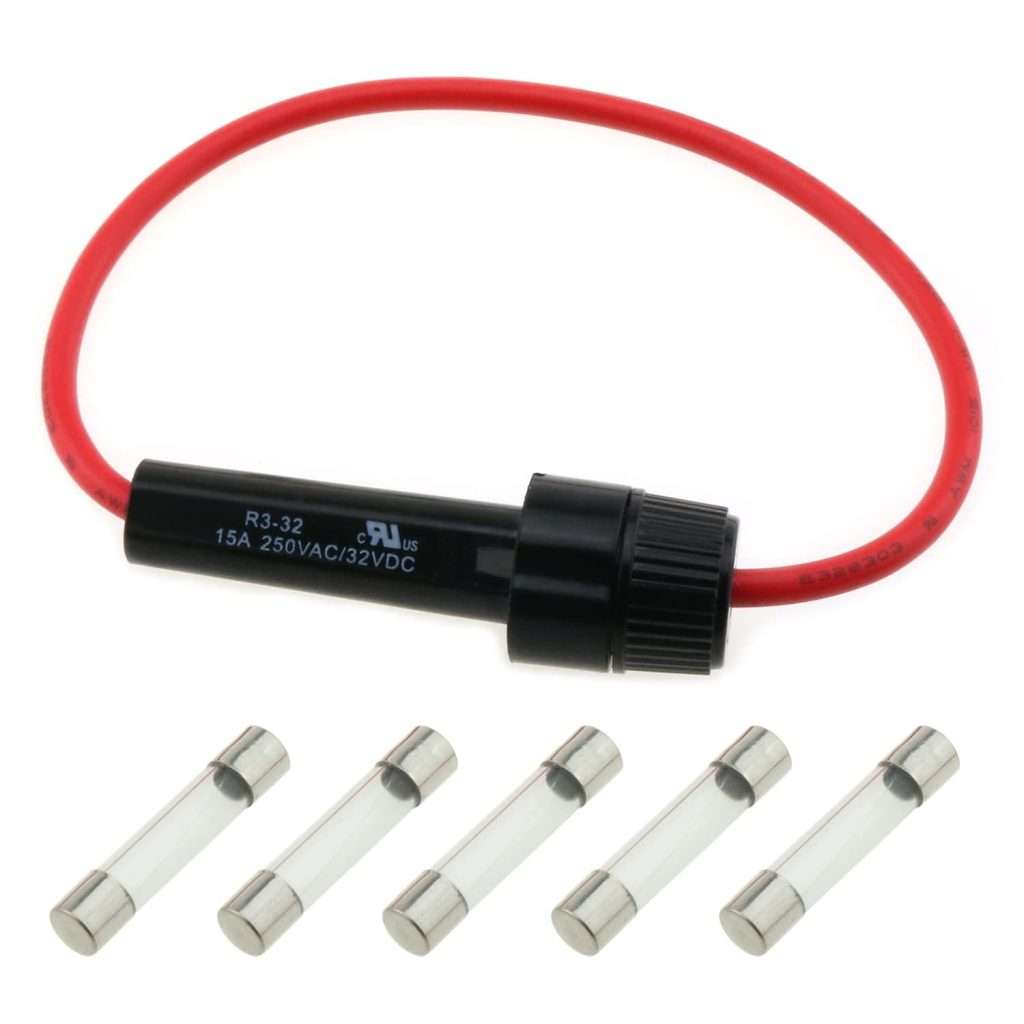
The 6IN1 Wired Mounting Fuse Holder with 5pcs 6×30mm 1A Fuse is a compact inline fuse-holder solution designed to provide replaceable overcurrent protection for electrical and electronic circuits. The product combines a wired mounting fuse holder with five replaceable 6×30mm glass-tube fuses rated at 1A, providing a convenient starting set for projects that require protection against excessive current.
Unlike a resettable circuit breaker, a conventional fuse is intentionally designed to open the circuit when current exceeds its rated operating conditions for a sufficient period. Once the fuse operates, it must be replaced with another fuse of the appropriate rating. The fuse holder provides the mechanical enclosure and electrical contacts required to install and replace the fuse without permanently modifying the wiring.
The “6IN1” designation refers to the product’s multi-purpose fuse-holder configuration rather than six independent electronic protection channels. The actual protection is provided by the installed fuse, while the holder provides the connection between the circuit wiring and the cylindrical fuse.
The supplied 6×30mm fuse format is commonly used in electronic equipment, control circuits, power supplies, appliances, lighting systems, and other low- to medium-current electrical applications. The included 1A rating makes the supplied fuses suitable for circuits whose normal operating current is comfortably below 1A and whose wiring and components have been designed around that protection level.
This type of product is particularly useful when a circuit does not have an integrated fuse holder. Instead of soldering a fuse permanently into the wiring, the inline holder creates a serviceable protection point. When the fuse blows, the user can disconnect power, open the holder, replace the fuse, and restore the circuit.
It is important to distinguish the fuse’s current rating from the maximum current capability of the holder itself. The supplied fuse is rated at 1A, but a complete installation must also take account of the holder’s electrical rating, conductor size, insulation, voltage rating, environmental conditions, and the characteristics of the protected circuit.
Technical Specifications
| Parameter | Specification |
|---|---|
| Product Type | Wired Mounting / Inline Fuse Holder |
| Configuration | 6-in-1 |
| Fuse Type | Cylindrical fuse |
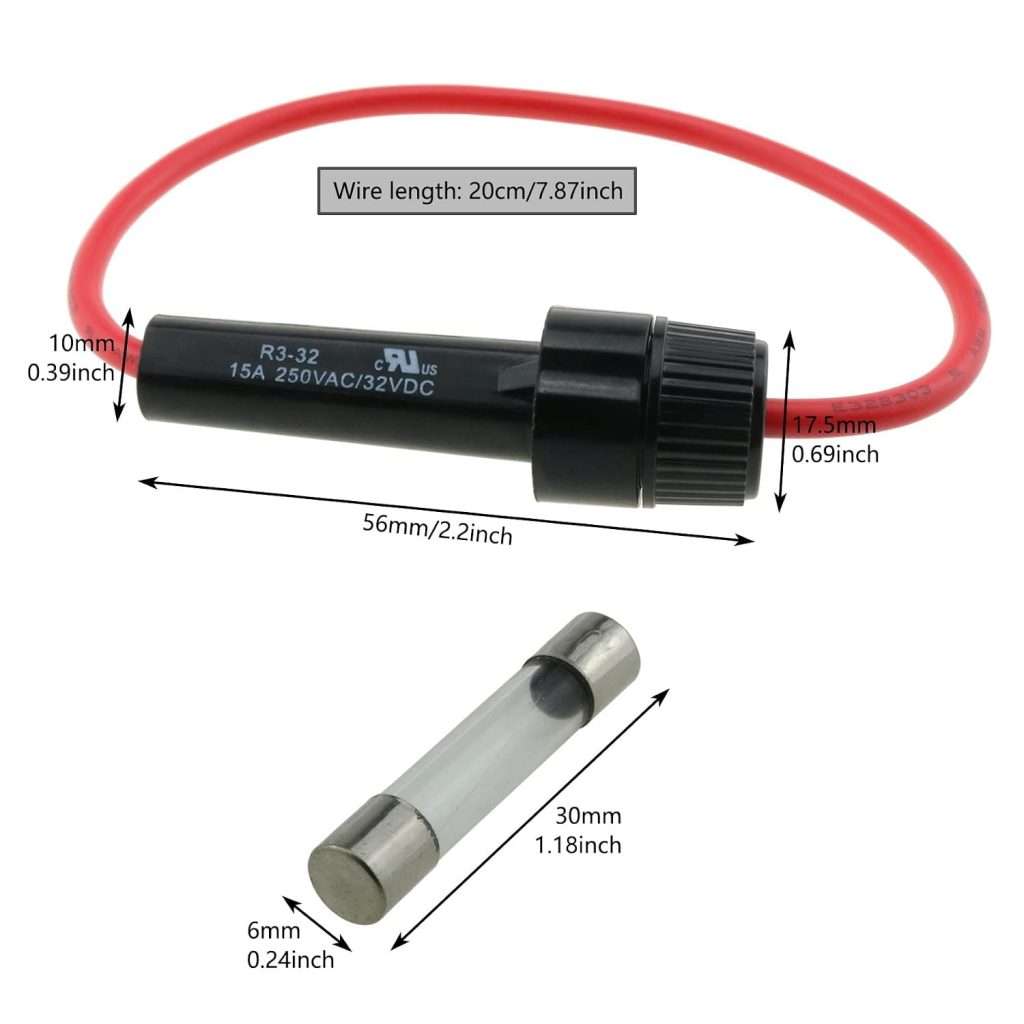
| Fuse Dimensions | 6 × 30 mm |
| Included Fuse Quantity | 5 pieces |
| Included Fuse Rating | 1A each |
| Fuse Construction | 6×30mm replaceable fuse |
| Installation Type | Wired / Inline |
| Mounting Style | Wired mounting |
| Primary Function | Overcurrent protection |
| Replacement | Replaceable fuse element |
| Typical Application | Electronic and electrical circuits |
| Protection Principle | Fuse opens circuit under excessive current |
| Fuse Resettable | No |
| Included Accessories | 5 × 1A fuses |
| Circuit Configuration | Series protection |
| Fuse Holder Role | Mechanical retention and electrical connection |
The available product description establishes the 6×30mm physical fuse size, the inclusion of five 1A fuses, and the wired mounting configuration. Parameters such as exact voltage rating, maximum holder current, wire gauge, insulation temperature rating, contact resistance, and certification should not be assumed unless explicitly provided by the particular manufacturer or supplier.
This distinction is important because cylindrical fuses with identical physical dimensions can have substantially different electrical characteristics. A 6×30mm fuse is a physical size designation, not by itself a complete electrical specification.
Key Features
6×30mm Replaceable Fuse Format
The holder is designed around a standard cylindrical 6×30mm fuse format. This relatively compact size allows the protection device to be integrated into equipment wiring without requiring a large external fuse box.
The removable design is particularly useful during troubleshooting. Instead of cutting or desoldering a fuse from a circuit, the user can access the fuse through the holder and replace it when necessary.
1A Protection Rating
The included fuses are rated at 1A. This makes the supplied fuse set appropriate for circuits specifically designed around a 1A protection point.
For example, if an electronic circuit normally consumes a few hundred milliamps, a properly selected 1A fuse can provide an additional layer of protection against abnormal current conditions.
However, a 1A fuse should not automatically be installed simply because the equipment operates from a low-voltage supply. Fuse selection must consider the circuit’s normal operating current, startup/inrush current, conductor capacity, load characteristics, and the manufacturer’s protection requirements.
Five Replacement Fuses Included
The package includes five 1A fuses, allowing several fuse replacements before additional components need to be purchased.
This is convenient during prototyping and repair work because fuse failure can occur during development when wiring mistakes or unexpected short circuits are encountered.
Keeping several replacement fuses alongside the equipment also reduces downtime during maintenance.
Inline Wiring
The wired configuration allows the fuse holder to be installed directly into an existing power conductor.
A typical arrangement is:
Power Source → Fuse Holder → Protected Circuit
The fuse is placed in series with the circuit so that excessive current passes through the fuse before reaching the protected load.
This arrangement can be significantly more convenient than designing a separate PCB-mounted fuse circuit when working with cables, enclosures, test equipment, lighting assemblies, or custom wiring harnesses.
Simple Mechanical Construction
A passive fuse holder does not require an external power supply, control electronics, firmware, sensors, or configuration.
Its operation is entirely electrical and mechanical: current flows through the fuse, and if the fuse element melts under an excessive-current condition, the circuit is interrupted.
This simplicity is one reason conventional fuses remain widely used in electrical protection systems.
Easy Maintenance
One of the most practical characteristics of a replaceable fuse holder is serviceability.
When a fuse operates:
- Disconnect the equipment from its power source.
- Open or remove the fuse holder.
- Remove the failed fuse.
- Inspect the holder and surrounding wiring for damage.
- Install an appropriate replacement fuse.
- Restore power and test the equipment.
The cause of the fuse failure should be investigated before simply installing another fuse. Repeated fuse operation can indicate a short circuit, overloaded circuit, defective component, wiring problem, or excessive startup current.
Application Scenarios
Power Supply Protection
The fuse holder can be installed in the input or output wiring of suitable low-current power supplies.
For example, a small electronic project powered from an external DC adapter can use an appropriately selected fuse to provide protection against downstream wiring faults.
The fuse should be selected according to the power supply characteristics and the circuit’s required protection level rather than simply matching the adapter’s maximum output current.
DIY Electronics
For hobby electronics, an inline fuse holder provides a straightforward way to add physical overcurrent protection without designing a dedicated PCB fuse circuit.
It can be useful in experimental power distribution systems, custom electronics enclosures, battery-powered projects, and prototype equipment.
LED Lighting
Small LED lighting systems can benefit from an inline fuse when the power source and wiring warrant additional protection.
For example, a custom lighting assembly may have a dedicated fuse installed near the power-input point. If a downstream cable becomes shorted, the fuse can interrupt the circuit and limit the duration of excessive current.
The appropriate fuse rating depends on the actual LED system and power supply; the included 1A fuse should only be used where its electrical characteristics are appropriate.
Automotive and Vehicle Electronics
The compact form factor can also be useful in selected low-current vehicle accessory circuits.
However, automotive installations require particular attention to vibration, temperature, moisture, voltage transients, wire insulation, and fuse specifications. Unless the specific holder is documented for automotive use, it should not automatically be treated as an automotive-rated component.
Test Equipment
Technicians can install an inline fuse holder into temporary test wiring to provide an additional layer of protection when experimenting with unfamiliar circuits.
This can be particularly useful during prototype development, where accidental short circuits may otherwise damage a power supply or expensive electronic components.
Small Motors and Relays
Small motors, relays, solenoids, and electromechanical loads can produce startup or switching currents that differ substantially from their steady-state current.
A fuse can still provide useful protection, but the fuse characteristic must be selected to accommodate legitimate startup current while responding appropriately to sustained fault current. Consequently, the included 1A fuse should not be assumed suitable for every motor or relay application.
Battery-Powered Projects
Battery systems can deliver significant fault current even when the connected electronic load normally consumes relatively little power.
Installing a properly rated fuse close to the battery or power source can help protect downstream wiring from short-circuit conditions.
For battery applications, the fuse voltage rating, interrupting capability, wiring capacity, and battery fault current should all be considered carefully.
Fuse Selection and Installation Considerations
A fuse should be selected based on the circuit, not simply the load’s nominal operating current.
For example, if a circuit normally consumes 500mA, selecting a 1A fuse may be reasonable in some designs, but the correct value depends on startup current, load characteristics, allowable overload duration, wire capacity, and the desired protection strategy.
The basic relationship between electrical power, voltage, and current is:
P = V × I
Thus, a 12V circuit drawing 1A represents approximately:
P = 12 × 1 = 12W
A 5V circuit drawing 1A represents:
P = 5 × 1 = 5W
However, this calculation does not mean that a 1A fuse is automatically appropriate for either circuit. Fuse selection depends on the circuit’s operating and fault characteristics.
The fuse should also be installed in the appropriate conductor. In many DC power systems, placing the fuse close to the power-source positive terminal helps protect the downstream wiring from a short circuit.
The fuse holder should be mounted securely, with exposed conductive portions protected from accidental contact and the wiring mechanically supported so that vibration or pulling forces are not transferred directly to the electrical terminals.
Competitive Analysis
The 6IN1 wired fuse holder can be compared with several alternative approaches, including PCB-mounted fuse holders, resettable polyfuses, automotive blade-fuse holders, and permanently soldered inline fuses.
| Characteristic | 6IN1 Wired 6×30mm Holder | PCB Fuse Holder | Resettable PTC | Automotive Blade Fuse Holder |
|---|---|---|---|---|
| Fuse Format | 6×30mm | Depends on design | No replaceable fuse | Blade fuse |
| Replaceable | Yes | Yes | Self-resetting | Yes |
| Included Fuse | 5 × 1A | Usually depends on product | N/A | Depends on product |
| Wiring Installation | Yes | No/limited | Usually PCB or inline | Yes |
| Maintenance | Simple replacement | Simple replacement | Automatic reset | Simple replacement |
| Physical Size | Compact | PCB-dependent | Very compact | Depends on model |
| Fault Reset | Manual | Manual | Automatic after cooling | Manual |
| Suitable for Prototyping | Yes | Yes | Yes | Yes |
| Best Strength | Simple inline protection | Integrated PCB design | Repeated transient protection | Automotive fuse compatibility |
A PCB-mounted fuse holder is preferable when protection must be incorporated directly into a circuit board. It provides a cleaner integrated design but requires PCB space and appropriate mechanical placement.
A resettable PTC offers a different operating principle. Instead of requiring manual fuse replacement, resistance increases substantially during an overcurrent event and decreases again after the device cools. This can be useful in circuits experiencing occasional transient overloads, but its electrical behavior differs from that of a conventional fuse.
An automotive blade-fuse holder may be more appropriate for vehicle installations when the design specifically requires automotive blade fuses. The 6×30mm holder instead provides a cylindrical-fuse interface and should not be treated as interchangeable with a blade-fuse holder.
Compared with soldering a fuse directly into a cable, the wired holder has a clear maintenance advantage: the fuse can be replaced without modifying the wiring.
Advantages and Limitations
The main advantage of this product is its simplicity. It combines a wired fuse interface with five replacement 1A fuses, providing a straightforward solution for circuits requiring replaceable overcurrent protection.
The 6×30mm format is compact enough for many custom enclosures, while the inline configuration avoids the need to allocate PCB space for a fuse holder.
The five included fuses are also useful for prototyping and repair. A failed fuse does not require the user to purchase a replacement immediately, provided the remaining supplied fuses are suitable for the application.
There are nevertheless several limitations.
First, the supplied 1A fuse rating is fixed. Users requiring 250mA, 500mA, 2A, or another protection value will need a suitably rated replacement fuse of the correct physical and electrical specification.
Second, the product should not be regarded as a universal protection module. It does not appear to include active current monitoring, voltage regulation, automatic reset circuitry, surge suppression, or electronic fault detection.
Third, the available product description does not establish detailed electrical ratings for the holder itself. Users designing safety-critical, high-current, high-voltage, or industrial equipment should obtain the manufacturer’s complete electrical and mechanical specifications before deployment.
Conclusion
The 6IN1 Wired Mounting Fuse Holder with 5pcs 6×30mm 1A Fuse provides a straightforward way to introduce replaceable overcurrent protection into wired electrical and electronic systems. Its combination of a compact inline holder and five 6×30mm 1A fuses makes it particularly convenient for prototyping, repairs, small power systems, custom wiring, LED projects, and general electronics work.
The fundamental operating principle is simple: the fuse is connected in series with the protected circuit, allowing normal current to pass while interrupting the circuit when excessive current causes the fuse element to operate. After a fault, the holder allows the fuse to be replaced rather than requiring the wiring itself to be modified.
The 6×30mm fuse format provides a practical balance between physical size and serviceability, while the wired mounting arrangement allows the holder to be positioned directly in a power cable. The five included 1A fuses provide immediate replacement capacity for appropriately designed circuits.
Compared with PCB fuse holders, resettable PTC devices, and automotive blade-fuse holders, this product occupies a straightforward niche: a replaceable cylindrical-fuse holder intended for inline wiring applications. Its advantages are ease of installation, replaceability, compact construction, and compatibility with readily replaceable 6×30mm fuses.
At the same time, the supplied 1A fuse should never be treated as a universal rating. Proper fuse selection requires consideration of operating current, startup current, supply voltage, wiring capacity, load characteristics, and the desired fault-protection behavior. Likewise, the exact holder voltage/current rating should be verified from the manufacturer’s documentation when used in demanding applications.
For general-purpose electronics and electrical projects where a compact, serviceable fuse connection is required, the 6IN1 Wired Fuse Holder with five 1A 6×30mm fuses provides a practical and uncomplicated protection solution. Its value lies less in sophisticated electronics and more in delivering a convenient, replaceable, and easily maintained physical protection point within a wired circuit.



