

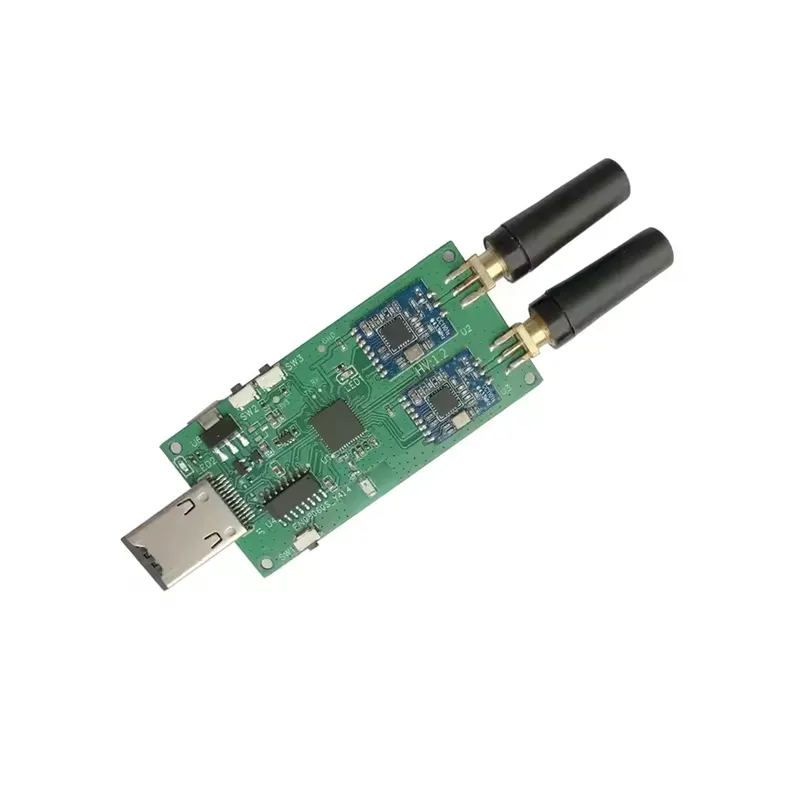

The Evil Crow RF2 CC1101 is an advanced radio-frequency research and development platform designed for authorized wireless security testing, embedded RF development, signal analysis, and protocol experimentation. Built around an ESP32 microcontroller and equipped with two Texas Instruments CC1101 sub-GHz RF transceivers, the platform enables simultaneous transmit and receive operations across multiple ISM frequency bands, making it significantly more versatile than conventional single-transceiver RF modules.
Unlike traditional USB-connected RF adapters that typically provide either transmit or receive functionality, Evil Crow RF2 integrates wireless networking, onboard processing, local storage, and a browser-based management interface into a compact standalone device. The ESP32 handles RF configuration, web-based control, storage management, and communication with the two CC1101 devices through SPI interfaces, allowing users to configure each transceiver independently.
One of the defining characteristics of the platform is its dual-radio architecture. Each CC1101 operates independently, allowing one module to monitor RF traffic while the other performs a separate transmission task. This architecture provides flexibility for legitimate wireless protocol analysis, interoperability testing, and evaluation of proprietary sub-GHz devices within authorized environments.
The CC1101 itself is a highly regarded low-power RF transceiver supporting configurable modulation formats including 2-FSK, GFSK, MSK, ASK, and OOK, making it suitable for communicating with a broad range of ISM-band devices. Combined with the processing capabilities of the ESP32, the platform provides an efficient environment for embedded developers, RF engineers, and cybersecurity professionals conducting lawful testing.
A web-based interface simplifies configuration of frequency, modulation, receive bandwidth, deviation, and data rate without requiring users to repeatedly recompile firmware. Captured data can be stored locally on a microSD card for later analysis, further enhancing the system’s usefulness during field testing and laboratory research.
It is important to note that RF transmission is regulated in many jurisdictions. The platform is intended for authorized research, learning, interoperability testing, and security assessments conducted in compliance with applicable laws and regulations.
Technical Specifications
| Specification | Details |
| Product | Evil Crow RF2 (EvilCrowRF V2) |
| Main Processor | ESP32 Development Module |
| CPU Frequency | 80 MHz (documented implementation) |
| Flash Memory | 4 MB |
| Primary RF IC | Dual Texas Instruments CC1101 |
| Additional RF | NRF24L01+ (2.4 GHz) |
| RF Frequency Coverage (CC1101) | 300–348 MHz, 387–464 MHz, 779–928 MHz |
| Supported Modulation | 2-FSK, GFSK, MSK, ASK, OOK |
| Programmable Data Rate | 0.6–500 kBaud |
| Receive Bandwidth | 58–812 kHz |
| Programmable TX Power | –30 dBm to +12 dBm |
| RF Interface | SPI |
| Storage | microSD (FAT32, ≤32 GB recommended) |
| Connectivity | Wi-Fi via ESP32 |
| USB | Firmware programming and power |
| User Interface | Browser-based web interface |
| Firmware | Open-source |
| Typical Applications | RF research, embedded development, protocol analysis, interoperability testing |
Specifications are based on the documented EvilCrowRF V2 hardware implementation and the Texas Instruments CC1101 transceiver.
Key Features
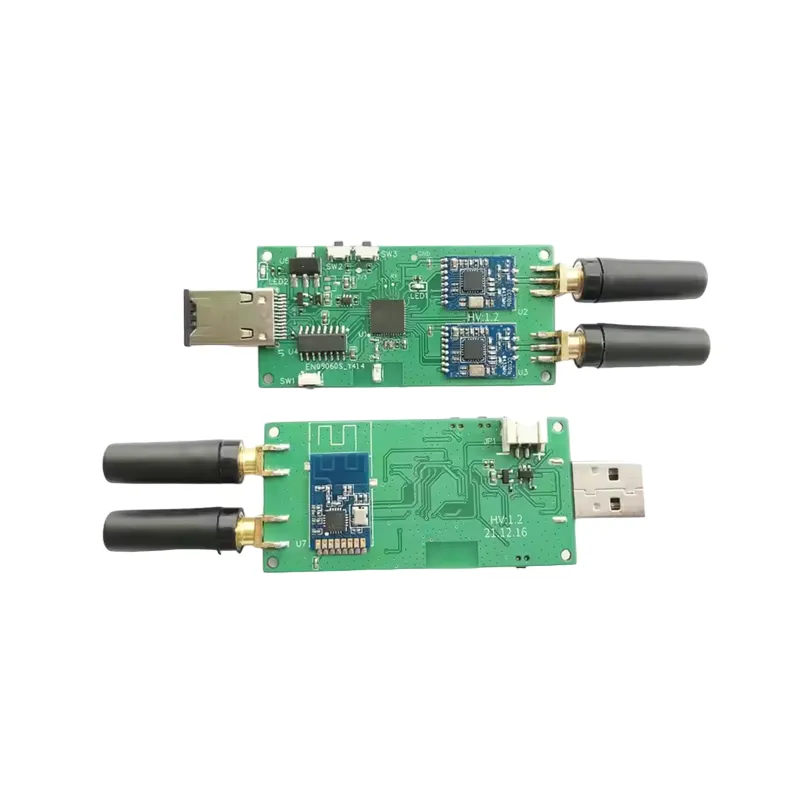
The most distinctive feature of Evil Crow RF2 is its dual independent CC1101 architecture. Each radio maintains separate control signals while sharing the SPI bus, enabling concurrent RF tasks that would otherwise require two separate devices. This design increases efficiency during protocol evaluation and wireless system development.
The CC1101 transceiver offers exceptional flexibility through programmable operating parameters. Developers can adjust center frequency, modulation method, channel bandwidth, deviation, transmission power, and data rate to match the characteristics of many sub-GHz wireless devices used in industrial automation, home automation, telemetry, remote controls, and sensor networks.
Integrated Wi-Fi allows the ESP32 to host a browser-accessible configuration interface. Instead of using command-line utilities or serial consoles, users can configure RF parameters, review captured signals, and manage stored data from a standard web browser.
The onboard microSD slot provides convenient storage for configuration files and captured RF data, reducing dependence on a continuously connected host computer.
Because the firmware is open source, developers can customize functionality, integrate additional protocols, automate testing workflows, or adapt the platform to specialized research projects. This openness has contributed to an active development community and ongoing firmware enhancements.
Application Scenarios
The Evil Crow RF2 platform serves a broad range of legitimate engineering and research applications.
In embedded product development, engineers can evaluate proprietary wireless protocols, validate communication reliability, and characterize RF performance before deploying commercial hardware.
Within industrial automation, the platform is useful for interoperability testing of sub-GHz devices operating in common ISM bands such as 433 MHz, 868 MHz, and 915 MHz, enabling developers to assess protocol compatibility during product development.
For wireless protocol research, configurable modulation and bandwidth settings allow experimentation with different signal characteristics, making the platform valuable for academic research and laboratory instruction.
Cybersecurity professionals may employ the device during authorized penetration testing and security assessments to analyze RF communication implemented by systems under their control. Such testing should always be conducted with appropriate authorization and in compliance with applicable regulations.
The dual-transceiver architecture also benefits RF troubleshooting, enabling engineers to monitor one channel while interacting with another device, reducing equipment requirements during debugging sessions.
Educational institutions can leverage the platform to demonstrate practical RF concepts including modulation techniques, spectrum usage, SPI-controlled transceivers, and embedded wireless communications.
Competitive Analysis
Compared with a single CC1101 development board, Evil Crow RF2 provides substantially greater operational flexibility through its two independent RF transceivers. Concurrent receive and transmit capabilities enable workflows that would otherwise require multiple devices.
Compared with inexpensive CC1101 breakout modules, Evil Crow RF2 offers a complete integrated platform incorporating an ESP32 controller, Wi-Fi connectivity, browser-based configuration, and removable storage. This reduces development effort and accelerates experimentation.
When evaluated against HackRF One, Evil Crow RF2 is considerably more specialized. HackRF offers wideband software-defined radio capabilities across a much broader frequency spectrum but typically at higher cost and with greater complexity. Evil Crow RF2 focuses specifically on configurable sub-GHz digital communication using dedicated hardware transceivers, providing lower power consumption and simplified operation for supported frequency bands.
Compared with Flipper Zero’s integrated CC1101-based Sub-GHz capabilities, Evil Crow RF2 distinguishes itself through its dual-radio design, open hardware architecture, browser-based management interface, and expandability. Conversely, Flipper Zero offers a polished portable ecosystem with broader integrated functionality beyond RF alone.
Potential limitations should also be considered. The CC1101 hardware supports only specific sub-GHz frequency ranges and cannot operate outside these bands. Applications requiring continuous broadband spectrum monitoring or arbitrary waveform generation are better served by SDR platforms. Additionally, RF performance remains dependent on appropriate antenna selection and proper impedance matching for the target frequency.
Conclusion
The Evil Crow RF2 CC1101 represents a thoughtfully engineered RF development platform that combines the proven performance of the Texas Instruments CC1101 transceiver with the flexibility of the ESP32 microcontroller. Its dual-radio architecture, browser-based management interface, onboard storage, and open-source firmware distinguish it from conventional single-transceiver development boards.
For embedded developers, RF engineers, educators, and authorized security professionals, the platform offers an efficient environment for sub-GHz wireless experimentation, protocol evaluation, interoperability testing, and embedded system development. The ability to configure modulation schemes, frequency, bandwidth, transmission power, and data rate provides considerable flexibility while remaining within the capabilities of the CC1101 hardware.
Although it is not intended to replace full software-defined radio platforms, Evil Crow RF2 excels within its intended role as a configurable sub-GHz RF research and development tool. Its combination of mature hardware, documented firmware, expandable architecture, and active community support makes it a valuable addition to laboratories, engineering workbenches, and educational environments where reliable sub-GHz wireless experimentation is required.



