


Overview
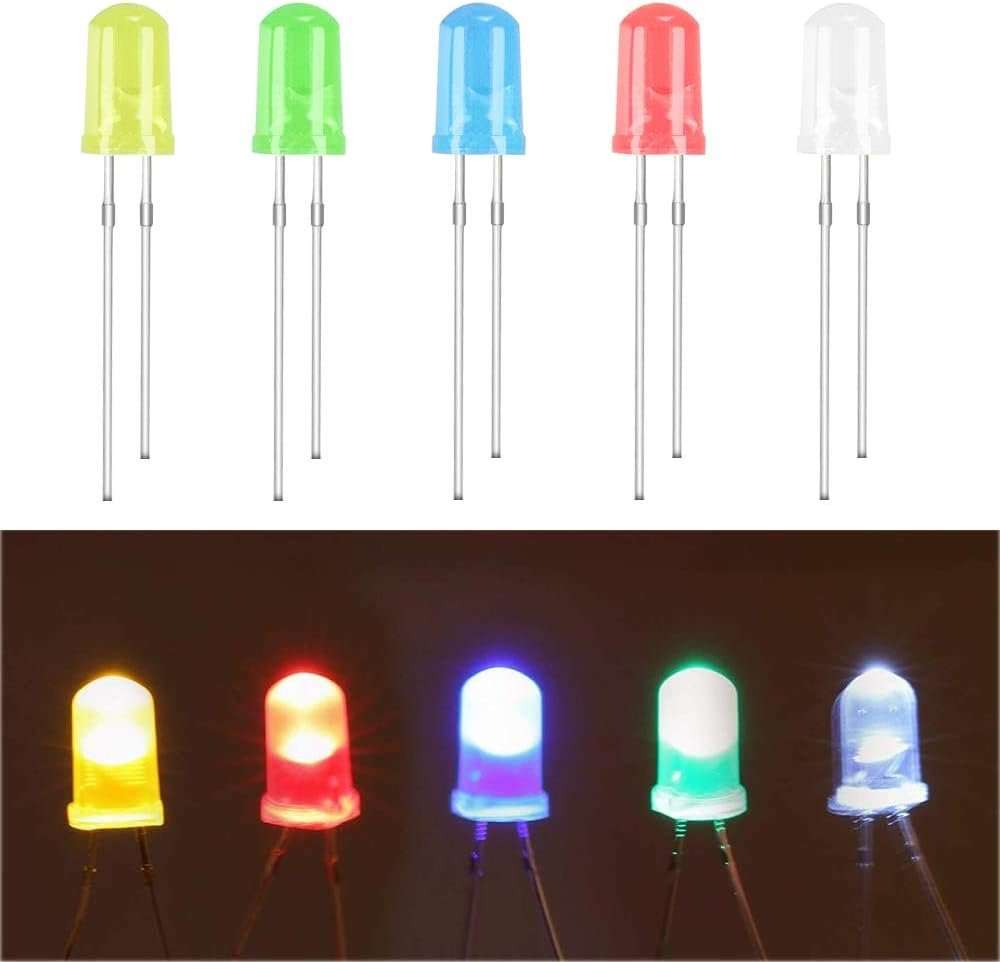
The MCIGICM 5mm LED Light Diodes Kit, Multi-Colored – 5 Color, 100 Pcs is a general-purpose assortment of through-hole light-emitting diodes intended for electronics experimentation, STEM education, prototyping, indicator circuits, decorative projects, and other low-voltage applications. The kit contains 100 individual 5 mm round LEDs divided among five colors: white, red, green, blue, and yellow, with 20 pieces of each color. Published product information identifies the kit as MCIGICM, with product identifier B07PG84V17 and UPC 727040387167.
Unlike a dedicated LED module containing integrated resistors, drivers, or a controller, this product is a collection of discrete LED components. Each LED is therefore intended to be incorporated into the user’s own circuit. This distinction is important when designing a prototype: an LED should not normally be connected directly across a voltage source without appropriate current limiting.
The kit’s five-color arrangement makes it particularly useful when several independent status indicators are needed in the same project. For example, a designer can use red for an error state, green for normal operation, yellow for warning, blue for communication activity, and white for illumination or general-purpose indication. In educational environments, the same assortment can be used to demonstrate polarity, current limiting, forward voltage, series circuits, parallel circuits, transistor switching, and microcontroller GPIO control.
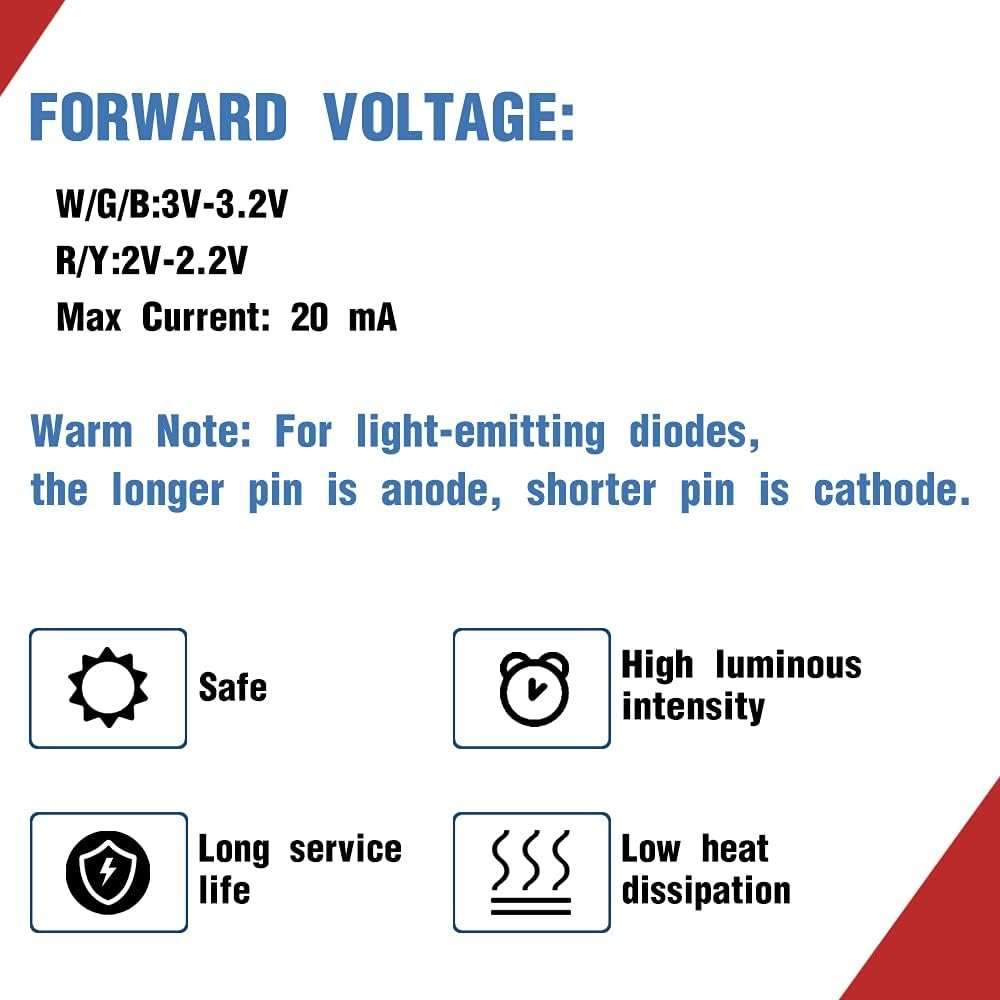
The published electrical specifications are relatively simple. White, green, and blue versions are listed with a forward-voltage range of approximately 3.0–3.2 V, while red and yellow versions are listed at approximately 2.0–2.2 V. The maximum current is specified as 20 mA.
It is worth emphasizing that these are assortment-level specifications rather than a detailed semiconductor datasheet for five individually characterized LED die families. The available product information does not provide detailed values such as luminous intensity, dominant wavelength, spectral bandwidth, reverse-voltage rating, viewing angle, chromaticity coordinates, or individual-bin tolerances. Consequently, those parameters should not be assumed when precision optical performance is required.
Technical Specifications
| Specification | Value |
|---|---|
| Product | MCIGICM 5mm LED Light Diodes Kit |
| Product Type | Assorted through-hole LED diode kit |
| Manufacturer / Brand | MCIGICM |
| Quantity | 100 pieces |
| LED Diameter | 5 mm |
| LED Type | Round-head LED |
| Colors | White, Red, Green, Blue, Yellow |
| Quantity per Color | 20 pieces |
| White Forward Voltage | 3.0–3.2 V |
| Green Forward Voltage | 3.0–3.2 V |
| Blue Forward Voltage | 3.0–3.2 V |
| Red Forward Voltage | 2.0–2.2 V |
| Yellow Forward Voltage | 2.0–2.2 V |
| Maximum Current | 20 mA |
| Mounting | Through-hole |
| Lead Configuration | Two-terminal LED |
| Material Listed | Copper |
| Dimmable | Not specified as dimmable |
| Product Identifier | B07PG84V17 |
| UPC | 727040387167 |
| Unit Count | 100 |
| Primary Applications | DIY electronics, STEM experiments, indicators, decorative projects |
The specifications above are limited to parameters actually published for this particular kit. The color allocation and electrical ranges are independently reproduced by multiple listings for the same product identifier.
Key Features
Five Useful Indicator Colors
The most obvious advantage of the assortment is the combination of five commonly useful LED colors. The kit provides white, red, green, blue, and yellow, allowing a single component assortment to cover a wide range of visual indication requirements. Twenty pieces of each color are supplied, so a project can use multiple LEDs of the same color without immediately exhausting the assortment.
For control panels and prototypes, the color selection can also establish a simple visual language. Red can represent a fault or inactive condition, green can indicate an enabled or normal condition, yellow can represent an intermediate or warning state, while blue and white can be assigned to communication, auxiliary, or illumination functions.
Standard 5 mm Round Package
The conventional 5 mm round through-hole format is one of the most useful characteristics for hobby and educational electronics. The package can be inserted into breadboards, perforated prototyping boards, sockets, and drilled panels.
Compared with tiny surface-mount LEDs, a 5 mm through-hole LED is easier to handle during manual assembly. Its relatively large body also provides a clear visual indicator on a prototype board. This makes the component particularly suitable for beginners who are learning component orientation and soldering.
Different Forward-Voltage Requirements
The five LED colors do not all have the same forward-voltage requirement. The published specifications group white, green, and blue at approximately 3.0–3.2 V, while red and yellow are specified at approximately 2.0–2.2 V.
This difference is electrically important. If LEDs of different colors are connected to the same supply, they should not simply be treated as interchangeable voltage loads. A current-limiting resistor or suitable constant-current driver should be selected according to the individual LED’s forward-voltage characteristics and the supply voltage.
For example, a 5 V digital circuit may require a different resistor value for a red LED than for a blue or white LED when the same target current is desired. The actual forward voltage also varies with current, temperature, and individual device characteristics, so the published ranges should be treated as design guidance rather than precision operating points.
20 mA Maximum Current
The product information specifies a 20 mA maximum current.
This value is useful when designing simple indicator circuits, but it should not automatically be interpreted as the recommended operating current for every application. In many modern microcontroller projects, LEDs can produce adequate visual indication at substantially lower currents. Operating at a lower current can reduce power consumption and may make GPIO-based control easier.
For production designs, the actual LED current should be established from the desired brightness, controller output capability, resistor calculation, thermal conditions, and the electrical characteristics of the particular LED.
Large Assortment for Repeated Experiments
With 100 individual LEDs, the kit is better suited to experimentation than a small handful of loose components. The equal 20-piece distribution also makes it practical for classroom exercises in which multiple students or groups need the same set of colors.
The assortment can be used repeatedly for breadboard experiments, microcontroller demonstrations, transistor-switching exercises, alarm indicators, and simple optical experiments without requiring a new component order for every project.
Application Scenarios
Breadboard Prototyping
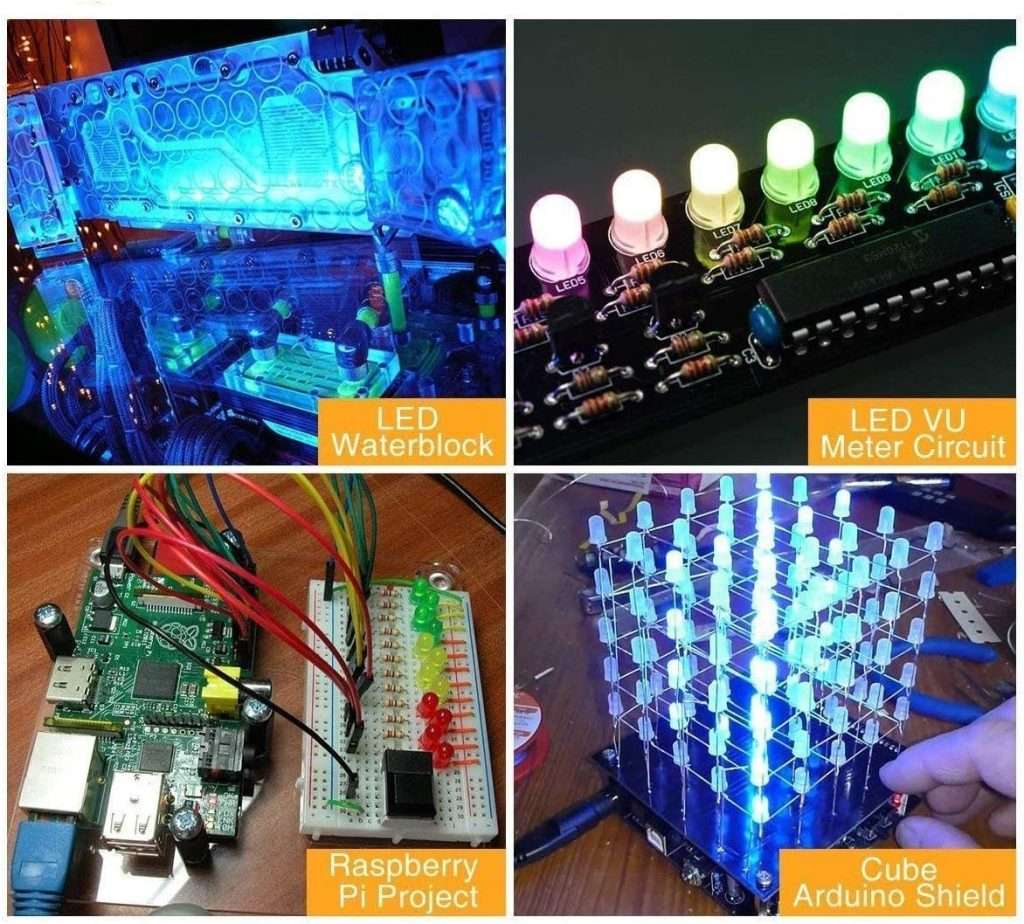
One of the most straightforward applications is breadboard-based circuit development. A 5 mm through-hole LED can be inserted directly into a standard breadboard, with a resistor placed in series to control current.
The five available colors make it possible to construct multi-state indicators during firmware development. A developer working on a microcontroller can assign separate LEDs to power, communication, error, activity, and user-status functions.
Arduino and Microcontroller Projects
The kit is also well suited to general-purpose microcontroller experiments. Digital output pins can drive individual LEDs through appropriate current-limiting circuitry, while multiple LEDs can be combined to demonstrate state machines, counters, timers, PWM brightness control, and sensor thresholds.
For example, an environmental-monitoring prototype could use green to indicate normal readings, yellow for a threshold warning, and red for an alarm condition. Blue and white LEDs could be reserved for communication and system-power indicators.
The important design consideration is that the LED current should be limited appropriately and should remain within the electrical specifications of the microcontroller GPIO. The LED’s stated 20 mA maximum does not mean that every microcontroller pin should be operated at 20 mA.
STEM and Classroom Experiments
The kit’s educational value comes from its simplicity. Students can observe that an LED is polarity-sensitive, compare different forward-voltage requirements, calculate resistor values, and investigate how current affects brightness.
The assortment can also demonstrate why different semiconductor materials produce different colors and why blue/green/white LEDs generally require a higher forward voltage than conventional red/yellow LEDs in this product family.
Signal and Status Indicators
The LEDs are particularly suitable for simple status indication. A small control board may require several visual states without needing a dedicated indicator module.
Because the components are discrete, the designer can position each LED exactly where the visual indication is needed. This is useful for prototypes, laboratory equipment, test fixtures, custom control panels, and hobby electronics.
Decorative Electronics
The white, blue, red, green, and yellow combination can also be used for decorative electronics, model construction, illuminated signs, small displays, and themed projects. Product listings specifically identify car decoration and DIY projects among the intended applications.
For decorative applications, PWM can be used to control brightness when the LEDs are driven by a suitable transistor, MOSFET, or controller. Again, the current should be limited rather than relying on the LED itself to regulate current.
Repair and Prototyping Stock
A 100-piece assortment can also serve as a general workshop component supply. Since 5 mm LEDs are common through-hole components, keeping several colors available reduces the need to purchase individual colors for small repairs or experimental circuits.
Competitive Analysis
The most appropriate comparison is not against a single integrated module but against other categories of LED assortments and indicator solutions.
Compared with Single-Color LED Packs
A single-color pack may be preferable when a production design requires dozens or hundreds of identical LEDs. Such packs simplify procurement and can provide tighter consistency within one color.
The MCIGICM assortment instead provides flexibility. Five colors in one package allow experimentation and prototyping without requiring separate purchases for every color. The trade-off is that a user who needs only one specific color may receive quantities of other colors that are unnecessary.
Compared with Surface-Mount LED Assortments
Surface-mount LEDs offer smaller PCB footprints and are generally more appropriate for compact production electronics. However, they are less convenient for beginners and manual breadboard experimentation.
The 5 mm through-hole format of this kit prioritizes ease of handling and visibility. For educational projects, hand-assembled prototypes, and larger indicator panels, that can be more practical than very small SMD components.
Compared with Addressable RGB LEDs
An addressable RGB LED integrates multiple LED dies and a control interface, allowing a single component to produce many colors under software control. Such devices are considerably more sophisticated for animated lighting and digital color effects.
The MCIGICM kit takes the opposite approach: each LED is a simple discrete component. There is no integrated controller, serial protocol, or firmware requirement. This makes the kit better suited to learning fundamental electronic principles, while addressable LEDs are more appropriate when individually programmable lighting effects are required.
Compared with Integrated LED Indicator Modules
Ready-made LED modules may include resistors, connectors, transistor drivers, or other supporting circuitry. They can therefore be easier to integrate into a finished system.
The discrete LEDs in this kit require the designer to provide the appropriate current-limiting and drive circuitry. That adds design work but also gives considerably more control over circuit architecture, current, placement, switching method, and brightness.
Conclusion
The MCIGICM 5mm LED Light Diodes Kit, Multi-Colored – 5 Color, 100 Pcs is fundamentally a practical assortment of conventional through-hole LEDs rather than a sophisticated lighting module. Its primary value lies in combining 100 individual 5 mm round LEDs, five commonly useful colors, and a balanced 20-piece-per-color distribution in one kit. Published specifications identify white, red, green, blue, and yellow LEDs, with white/green/blue forward voltage listed at 3.0–3.2 V, red/yellow at 2.0–2.2 V, and a maximum current of 20 mA.
From a hardware-development perspective, the standard through-hole package makes the assortment particularly convenient for breadboards, prototype PCBs, laboratory experiments, educational demonstrations, indicator circuits, and manually assembled projects. The five colors also provide enough variety to implement simple visual status schemes without buying several separate LED assortments.
Its main limitation is the relatively small amount of detailed electrical and optical characterization published for the product. The available product specifications do not establish precise luminous intensity, wavelength, viewing angle, reverse-voltage rating, or binning information for each color. Therefore, the kit is best regarded as a general-purpose prototyping and educational component assortment, rather than a precision LED solution for applications where optical consistency or tightly controlled electrical parameters are required.
For hobbyists, students, educators, makers, and engineers building prototypes, however, the combination of standardized 5 mm packaging, five colors, and 100 total components makes the kit a useful general-purpose LED stock item. Its simplicity is also one of its strongest practical characteristics: there is no proprietary interface or driver to learn, so the LEDs can be incorporated directly into conventional resistor-limited circuits, transistor switches, microcontroller projects, and experimental electronics.



